Life starts at sixty. Everyone knows that. Which is why I had heart surgery a week ago, quit my job, and plan to go trail running this week in the Collegiate Peaks. I’m focused on new beginnings.
My heart 2.0 has been operating fairly smoothly since the ablation. I track it throughout the day with the fourth frontier EKG chest strap that displays metrics to an app on my iPhone. I can track it for hours. It was recordings from this app that I was able to share with my primary care to begin diagnosing the problem. Cost about $500 but very cool tech. There’s an online dashboard for EKGs but below are before and after surgery EKG summaries from my app. Until today’s run, I’d yet to record A-Fib post surgery.
A-Fib 85% of the time on this run before ablation
A much nicer looking chart post surgery
After a week of taking it easy, I ran four miles today and recorded some A-fib for the first time – which is normal so it didn’t bother me. My pace was slower than normal though. Time to get back in shape. I’m registered for the Austin Marathon in February.
4 miler
Everything is of course new to Margot. This is her first halloween and we took her to Munson farms where we took Brit and Ellie for their first pumpkin patch experiences.
Munson Farms
Margot was hard to keep up with as she romped through the pumpkin patch
Karen finally caught up to her.
It was a bright, sunny October day.
Margot picked out a pumpkin her size and no doubt dreamt of witches and goblins last night.
Point zero on the Trans Canada Trail (AKA Sentier Transcanadien) starts in Victoria BC. Literally a couple of miles from my condo along the coast. I know because I was there today. Just past St. Ann’s Academy and through the middle of Beacon Hill Park. This initial 4.5 mile section is termed the Dallas Road Waterfront.
I didn’t have to cut through Beacon Hill Park, but with a maze of endless grass trails that pass fragrant flower gardens, why would I choose a route along an urban street? I ran up over the hump of Beacon Hill itself for the view it provided of the Straight of Juan de Fuca.
The Straight of Juan de Fuca
The Dallas Road Waterfront trail is asphalt, not as bad as cement, and it is an urban trail after all. What I found more amazing than the view was the dog park that ran alongside it for a good mile.
Dog Park by the Sea
This park for pampered pups didn’t end until it literally collided with the ocean. And that is point zero of the Trans Canada Trail.
According to tribal history, the Ute people have roamed the lands of the Routt National Forest since the beginning of time. They were the first peoples to inhabit Colorado and eons before they adopted the horse from the Spanish, they formed the first human Colorado mountain trails. This weekend, Eric and Anthony relied upon the Ute spirits to give them strength as they roamed the trails above Steamboat Springs for the Run Rabbit Run 100 mile ultra.
The start to the tenth annual Run Rabbit Run
Anthony brought Ellen along for the trip. They went to school together with Eric at Beloit College. Ellen ran on the women’s track and cross country teams while Anthony and Eric ran on the men’s teams. Anthony and Ellen married in 2019, just like Brit and Eric, as if they’d predicted the pandemic. Ellen is a nurse in Minneapolis, studying to be a nurse practitioner. Anthony is a biologist/ecologist, studying to be a mechanical engineer. They say you never stop learning.
Across the creek at Fish Creek Falls
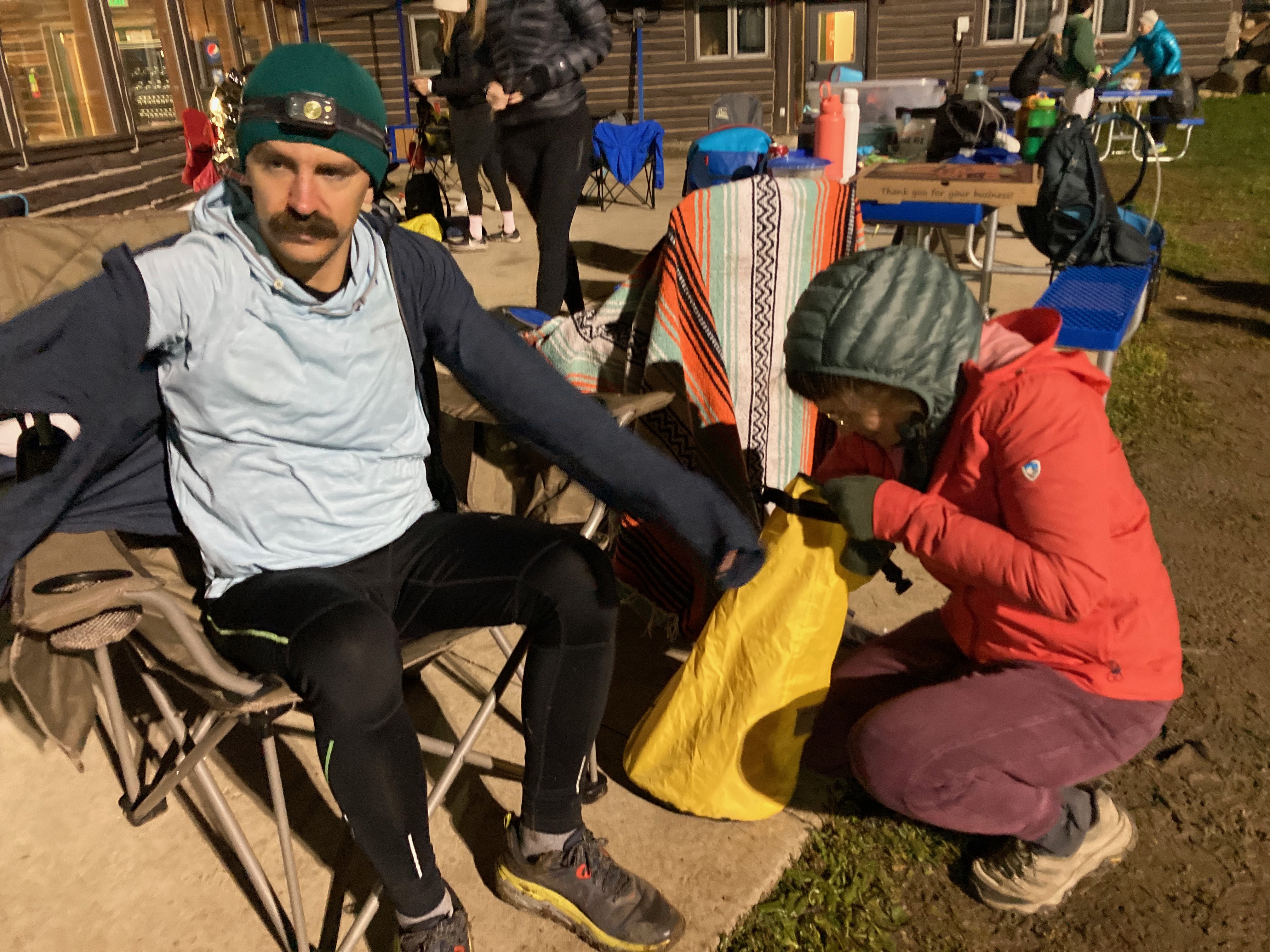
Brit, Margot, Ellen and I crewed Eric and Anthony at the first aid station we could reach, Fish Creek Falls. It’s a three and a half mile drive outside of town. Eric came in a few minutes under pace feeling strong, not in the top ten, but after ninety minutes of running, within range. He didn’t ask for all the gels he’d planned to consume, which left us wondering if he was running too hard.
Anthony at Fisk Creek Falls
It’s funny Anthony looks to be running by himself above because he was with a large pack of other runners at this point twelve miles into the race. Like Eric, he was essentially on his planned pace. True to his analytical nature, Anthony would run the entire distance to plan. Eric was another story.
Siobhan and Tracy
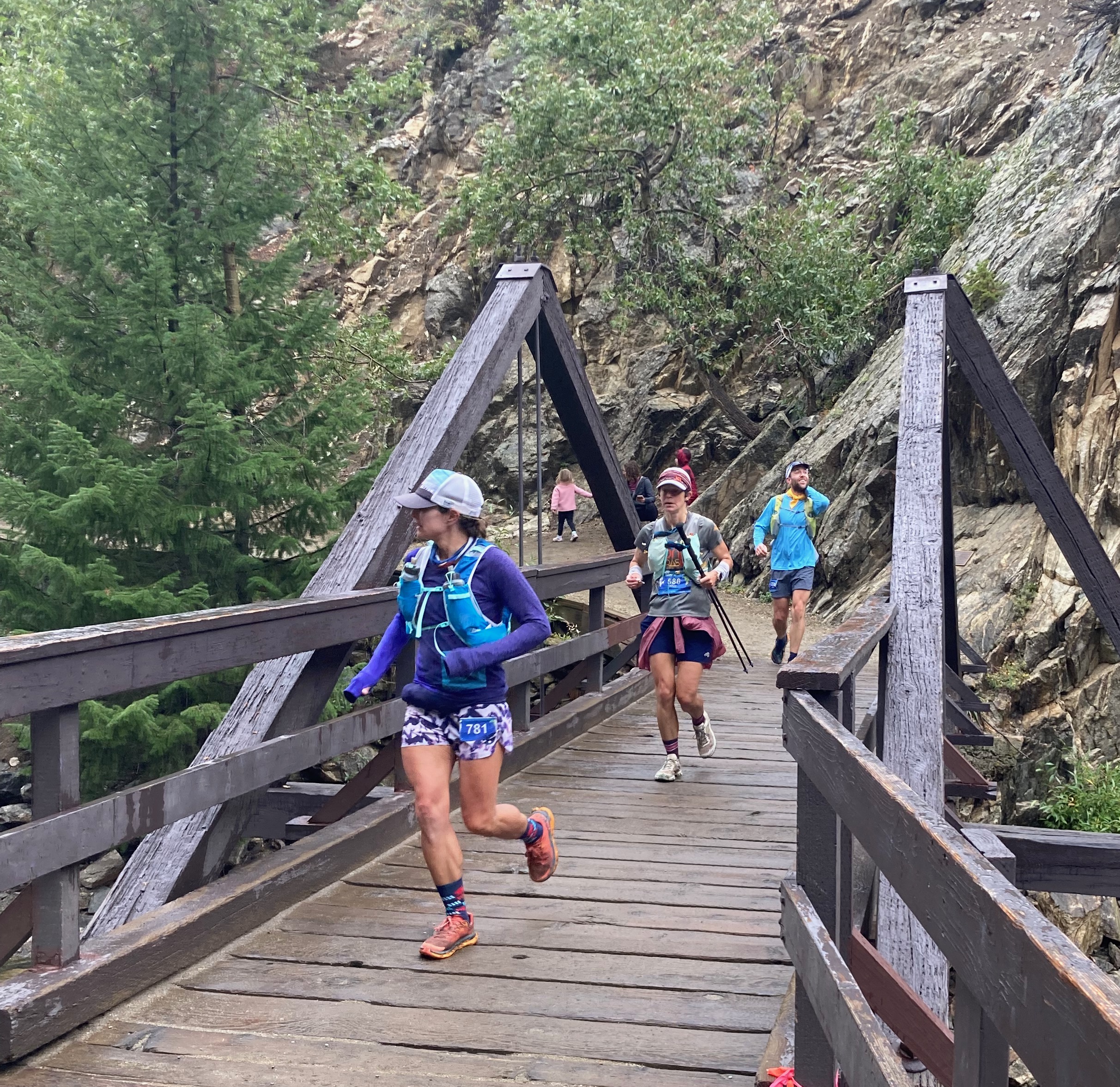
The women were fun to watch run through aid stations or out on the trail because they shared such strong camaraderie and spirit. A couple of 40-49 year olds are pictured here crossing the bridge over Fish Creek – local trail runner Siobhan Pritchard from Steamboat and Tracey Larsen from Breckenridge.
Addy Rastall won the women tortoises race
Addy Rastall, also of Steamboat, paced neck and neck the entire 100 miles with Heidi Farfel from Carbondale. They would eventually finish first and second – top ten overall. I’ll finish the women theme with the pair below with Fish Creek Falls in the background. Their bib numbers aren’t visible so I couldn’t get their personal details.
The race timing provided online tracking at a dozen checkpoints, counting the finish. This allowed us (the crew) to meet up with our runners at the few aid stations where we were allowed to crew without having to hang out all day waiting, because we could estimate their arrival based on their pace. Eric hit the Dry Lake aid station about two hours under pace and in fourth place. We panicked upon this discovery but beat Eric to the Olympian Hall aid station a good fifteen minutes ahead of him. This was where I planned to join Eric as a pacer for the segment termed the Lane of Pain – a twelve mile segment with an 8% grade for the first three miles.
While waiting for Eric’s arrival, the wind kicked up and the rain fell hard. I looked for Eric under a tent like the boy in Cat in the Hat staring out the window thinking if the sun will not shine, it is too wet to play. I shall sit under this tent on this cold, cold, wet day. But Eric showed up still in fourth place and ready to run up that steep, muddy hill. I was more dead weight than a pacer and couldn’t keep up with Eric. Three miles later, I reached the summit about a minute behind him. He continued on for another three-plus mile loop while I waited for him at the aid station.
We knew I wasn’t fit for the full twelve miles and planned to rejoin Eric for the drop down the six mile descent back to the Olympian Hall aid station. The Lane of Pain route was a figure eight with the aid station at the intersection. The descent was twice as long as the ascent, but consequently much more shallow with generous switchbacks. Eric paused for maybe one minute at the aid station and launched back down the single track as the darkness of night replaced the light of day.
I couldn’t keep up with Eric on the way down the Lane of Pain anymore than I could going up. He left me in oxygen debt almost immediately. Just as well as my headlamp didn’t provide enough lumens for me to run too fast. I ran as fast as I could in the darkness but fell three times. Once by tripping over a tree root. I fell hard on that one. Then by slipping in the mud. Lastly, I rolled my ankle. Fortunately, the mechanics of my ankles allow me to run again right away. A blessing for trails. Eric reached the bottom in third place. With over half the course behind him, he was running fast and we were concerned he might blow up and DNF. A couple of hours later, Ellen and I crewed Eric as he completed the Lane of Pain.
Ellen crews her husband
We drove Matt, another of Eric’s running buddies, up to the Dry Lake aid station on Buffalo Pass to pace Eric for the final thirty-plus miles overnight. His original pace would have had him finish at 8am. With his competitive bid, we were now projecting a finish between 4am and 6am, assuming he finished at all.
Fortunately for the crew, Eric crossed the finish line at 6am – after twenty-two hours and twenty-three minutes in first place for the tortoises division. The only person to complete the course ahead of him was the first place finisher for the hares division which started four hours after the tortoises. Eric would have placed twelfth had he competed with the hares, something he’ll have to consider for his second 100 mile ultra.
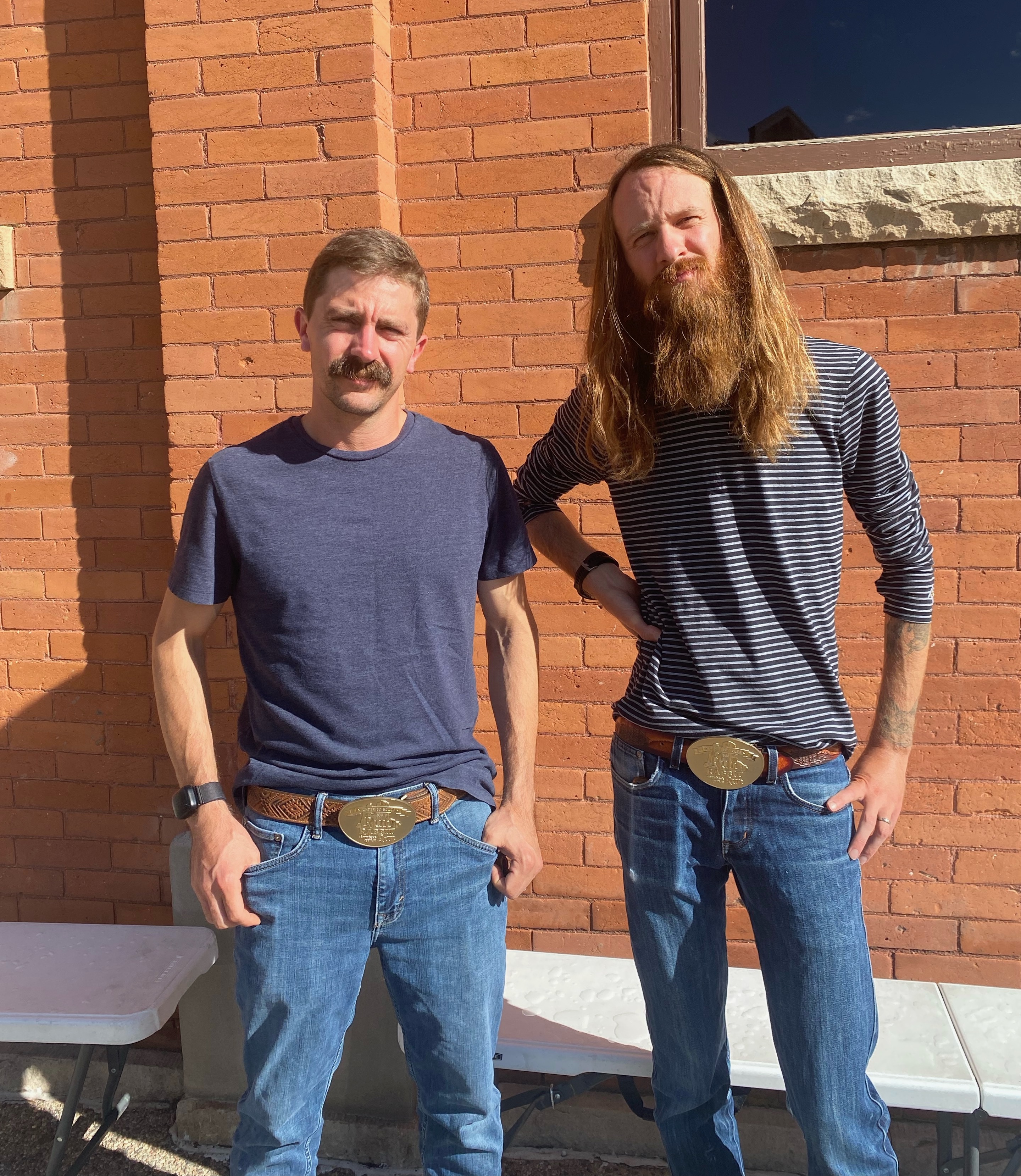
In an event where it’s common to drop out, Anthony finished as well at the more gentlemanly hour of 12:30 in the afternoon. Both runners felt strong to the end as they completed their very first 100 mile ultras. They celebrated by purchasing leather belts in town to go with their customary award belt buckles.
I ran four and a half miles yesterday, my first exercise beyond walking in the last two weeks. It felt so good. The soreness in my legs this morning is a welcomed sign that I’m back on track to train for a marathon. Maybe not an October marathon anymore, but one while I am still sixty. I have until next April.
I met with my cardiologist Friday and she assured me my heart is healthy. She scheduled more exams and visits with other specialists to determine what triggers my irregular heartbeat, but other than it forcing me to walk on some runs, my health isn’t in danger. She cleared me to run again. She’s a runner. She gets me.
After a couple of melancholy weeks, I left her office almost manic. I can imagine how the importance I assign to running might appear juvenile to others, but it’s my North Star. It’s been a constant throughout my life. My successes and failures running mirror other aspects of my life. Having this almost inane abstraction to real life helps me cope. I’m a runner. There are worse habits.
My next big running event won’t really involve me running. I’m going to serve as crew chief for my son-in-law as he runs the Run Rabbit Run 100 miler in Steamboat next month. It’s an elite event with some of the world’s best ultra trail runners. The photo above is of Addie Bracy, the female winner of last year’s event. With a $75,000 overall purse, $15,000 will go to each of the men and women’s winners. As crew chief, I’ll have unimpeded access to all of it. Life is good.
Summer is over. This weekend’s weather was meant for running. I sat on the couch this morning with the doors wide open so that my one dog who doesn’t like to go outdoors when the grass is wet from the overnight rain could enjoy the cool air.
I’ll meet with a cardiologist next Friday. She’ll review what I’ve already seen with my untrained eyes. The anomalous electro cardiogram readings. Video showing the valves of my heart push blood via a sonar-generated echo cardiogram. She’ll diagnose the likely cause, tell me my condition is mild and suggest treatment for what my ignorant readings have already led me to believe – I’ve enjoyed too much coffee in my lifetime. I cancelled my online auto-delivery of a coffee and chicory creole blend this morning. I’m struggling to find a decaf version.
“Childhood living Is easy to do The things you wanted I bought them for you“
When I was young, healthy and strong, I imagined myself a race horse. It wasn’t a stretch of my imagination. I ran NCAA track and cross country. I lived in an athletic dorm overflowing with Texan football players. I thought of us all as race horses. Tirelessly trained and running for the entertainment of others. I didn’t feel cheapened by it though, I imagined my body was that of a powerful animal and I liked it.
I sometimes still recall how I used to consider myself a race horse. I try to reimagine myself that way. The daydream is different now. I’m no longer on the track racing alongside other stallions. I picture myself as a wild horse galloping through an alpine meadow. I’m alone now, having left the younger horses to sprint and fight and mate. I’m looking for a place painted with wildflowers where I can lay down to watch the younger horses sprint and fight and mate.
“Wild horses Couldn’t drag me away Wild, wild horses Couldn’t drag me away“
The last twenty-four hours have done their best to kill running as I know it. First, a local running hero for me, who regularly runs extreme, elite events around the world, who writes a top-rated running blog and is invited to those world class events all-expenses-paid because of her influence, who does everything I’ver ever wanted to do as a runner and for that is my hero, fell down while cleaning her dog and broke her arm and ribs and punctured her lung. Apparently she’d exceeded her limits washing her dog. Then, this morning, my doctor told me to stop running.
***Insert expletive here***
I mean, running is what I do. I’m a runner. I’ve been writing a runner’s blog for over ten years. It has several hundred subscribers. That’s what I use to promote my novels. I was training for a marathon in October. I’m still sort of processing. I have to take a daily baby aspirin now.
***Insert a more creative expletive here, the first one was insufficient***
To be fair, I only have to stop running until I complete a more exhaustive cardiology exam and treatment, but that marathon is now out-of-reach. Hopefully I’ll be fit enough to run the half marathon since my sister is flying into town to run the half. I know this is actually good that I learned a thing or two about my health condition and it’s all temporal, but I went in there this morning expecting to be told to lose some weight. I was ready for that. Not this.
Yesterday, I completed week one of yet another ten week plan to prep for the Boulder Marathon. I’ve been down this road before. Seems like just last year I trained for this marathon with only ten weeks of running. There’s more riding on this one though. This time around, I’ll be running a marathon at sixty years of age.
Like last year, I’m not starting completely out-of-shape. Last year I’d been running weekends. This year, I’ve gone a full month without running, but I squeezed in some good hiking in July. Those four days of backpacking with Rob in the Mount Zirkel Widlerness Area set me up directionally for marathon training. I’ve lost three pounds since that hike. So, I feel like I have a leg up on these ten weeks.
I setup a mileage plan. Not overly aggressive, I won’t strive for over seventy miles in a single week. And really, I doubt I’ll run more than fifty. The primary goal though starting out is consistency. I targeted thirty-five miles this first week, and next, but the bigger goal was to run every day. I hit thirty-four miles. Close enough. I ran all seven days and that’s the victory I’m taking out of week one.
One particular run, Tuesday I think, felt pretty good because the weather was a bit cooler. Several of the runs have seriously sucked. Saturday was one of those. It was also my longest run at seven miles, but I walked a bit in every one of those miles. Not sure why. Could have been heat and humidity. Maybe I didn’t recover fully from Friday’s late afternoon run. My heart kept racing to over 170 beats per minute and I just had to stop running.
I developed a pattern of running for two or three telephone poles and then walking one. I relabelled my run an interval workout. If you’re going to establish hard-to-reach goals for yourself, you need a few tricks like that. I don’t have a coach looking over my shoulder so I take some liberties. I’m trying not to get too psyched out about not being able to control my heart rate. It felt horrible though. At around 170 bpm, my legs forced themselves to walk. Then my heartbeat would immediately shoot up to about 180 and I’d feel dizzy and nauseous for 10 or 20 seconds. My heart rate maxed out at 185. That’s kind of scary when you’re sixty.
The weather will be cooler though in October for the marathon. And I expect I’ll be a few pounds lighter. It’ll be hard to maintain my consistency with some upcoming travel plans – Austin later this month and British Columbia in September. I’m mapping out my running routes now though. Nine more weeks to go.
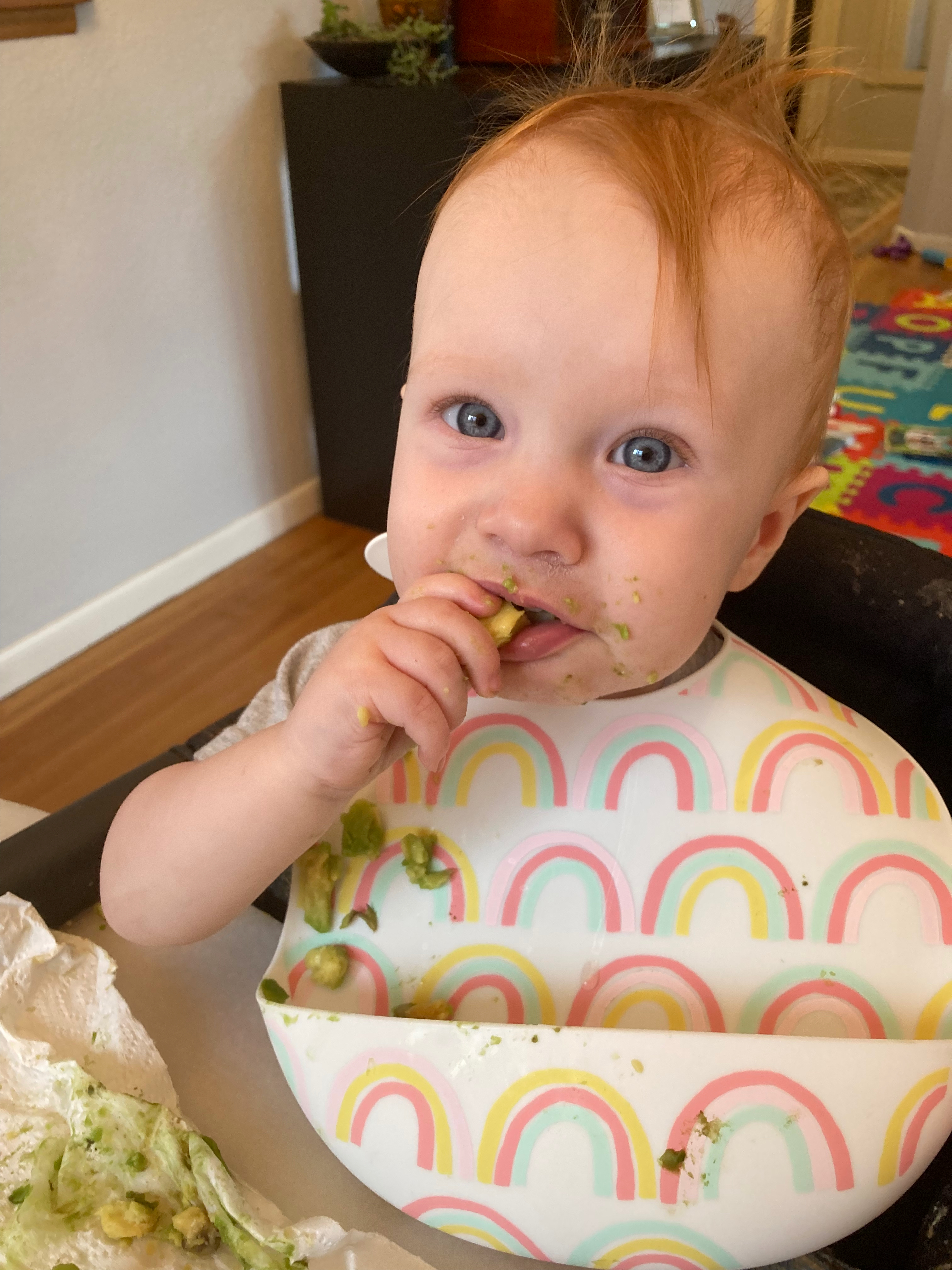
I ended the day babysitting Margot. At ten months, she can stand and take a few steps. And she loves stuffing her cheeks with avocado.
I dusted off my hydration pack this weekend. With 102° yesterday and 90° today, without hydration, running was an existential life choice. With a belly bigger than Dallas, I feel the choice was made for me. I had to get out there and acclimate myself. This summer’s not trending any cooler.
I have only one tank top to my name, a TrackSmith racing singlet gifted to me over Christmas by my brother-in-law. I chose wisely to wear it Saturday for the really hot one. I’ll need more if I hope to survive this summer.
I ran five each day, walking roughly two miles of them. I shamelessly count my walking as part of the run distance. I’m conditioning myself for a sixty-mile backpacking adventure next month at altitude. Should be cooler at twelve thousand feet where these fields of blooming bindweed and prairie dogs will be replaced by alpine buttercups and mountain goats. Ah, summer.
My little sister Nancy said she was thinking about running the Austin Half Marathon. I dared her to. Then I double dared her. And then I said if she would run it, I’d run it with her. It would be my third Austin Half. By the time we were finished daring each other to train through the winter, my brother, another of my sisters (I have countless sisters and grew up playing with paper dolls), and two of my many nieces all found themselves day-drinking in a swanky Austin hotel.
I wasn’t always playing with paper dolls while growing up. My brother is five or six years older, depending on the season, and taught me to play sports. He taught me to throw and hit a ball right-handed. Turns out I’m left-handed.
After a day and a half partying in downtown Austin, Nan and I found our way to the starting line Sunday morning. I gifted her the tech t-shirt the Christmas before last. A tip for other self-published authors; never overlook the opportunity of leveraging your siblings as billboards.
Nan was still smiling at mile 12 as she crossed the bridge over Lamar. Youth.
As we passed the Capitol, with maybe 200 yards to go, Nan had the audacity to ask me how much further we had to run. Thinking back, that was most of our conversation over the 13 mile course.
My sister Sandy captured our final steps on video, proof of another Austin Half completed.
Sandy led our nieces, Michelle and Brook up and down South Congress for the 5K.
They finished, hardly breaking a sweat. But then it was only forty-some degrees outside, which is chilly for Austin.
We all found ourselves at the finish for a team photo. And before everyone returned home to our five respective states, I turned them on to the amazing fries at Hyde Park Bar and Grill.
It’s not unusual for long runs, marathons and half marathons, to begin at sunrise. A 100K (62 mile) ultra will take you from sunrise to sunset. My son-in-law Eric is taking his first steps in this photo above in the Black Canyon 100K Ultra yesterday.
I wasn’t there to crew this time around, so I began my morning viewing the photos stream into my mobile. It seemed a no brainer to then choose “ultra” for my starter word in my morning Wordle ritual and I was rewarded with a hole-in-one, guessing correctly on the first row. Still, I was jealous of Eric’s parents getting to crew him to glory. Eric’s running mate, Matthew is standing to the right in the photo above.
Margot was the youngest member of the crew, held here in the early morning hours by her grandmother, Julie.
Eric called Brit a third of the way into the run to tell her he was considering dropping out. He felt that he had heat exhaustion. Black Canyon is high-altitude desert north of Phoenix. My response to that is, if you have never DNF’d in an ultra, then you haven’t run enough ultras. Brit told him to tough it out to the next aid station to see how he felt. Ten hours later, he was crossing this finish line.
I met with Ellie today at Atomic Bob’s Burgers in Golden for lunch. A bit of a hole-in-the-wall but decent burgers. Running afterwards wasn’t easy on a full stomach and I found myself walking a bit. And it was windier than Alexa led me to believe, but it was a good sun and nice to get outside.
I’ve noticed a surge in book sales this past week from the UK, followed up by more reads than usual from the UK on this blog. I thought maybe they were finding my book by searching for Crimea or Ukraine since my second novel touches on that topic. Reviewing the analytics on it though showed the clicks coming from queries for cyber, cybersecurity and cyberpunk. Cyber, cyber, cyber.
Could still be related to the current events between Putin and the Ukraine. My book details the Russian use of cyberwar as a prelude to combat, hence the title – Full Spectrum Cyberwar. There are some good non-fiction reads out there if you want to brush up on the topic, as the Brits are apparently doing. I recommend fiction though, to keep things light.
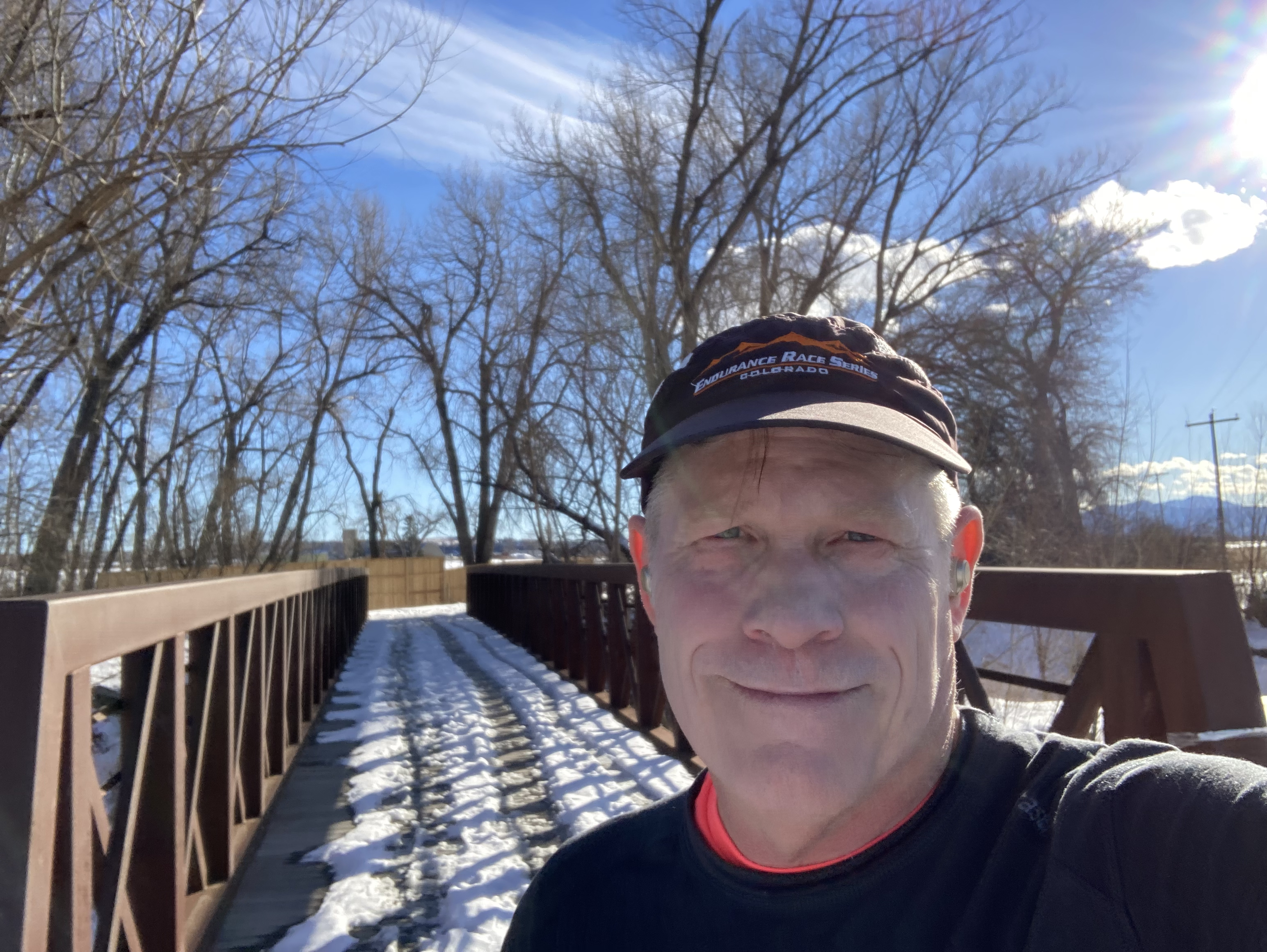
With seven miles on the LoBo Trail today, I’ve had my first winter’s run of the season. I started out the year with a cold and hit the elliptical during the dark hours of the work week once I could breathe again, so this was a late start to my winter running routine. I could not have asked for a more perfect winter’s day to get outside.
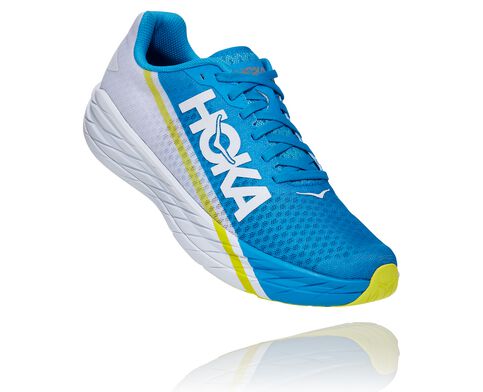
It snowed a couple of times during the last week, so visually, the trail was in season. I wore the wrong shoes, my Hoka Rocket X road shoes, so I had zero traction for much of the trail. That wasn’t ideal but I know now that I need to transition my gear. That’s what the first run of any given season is all about – the learning curve.
Karen and I are talking about snowshoeing tomorrow. Brit has been walking with Margot nearly every day, acclimating her to become a Colorado girl. She’s a little snow princess.
The Austin Boardwalk isn’t really a boardwalk. It’s stamped cement slabs laid atop an iron framework and cement piers, but it does hover beautifully over Town Lake. And I ran across it for the first time today. When I ran around Town Lake, clockwise, as a high schooler forty years ago, after crossing the Longhorn Dam, I then had to run along East Riverside Drive until I reached I-35 where I could cross the lake again to the north side for the running trail. So, the misnamed boardwalk is a very nice improvement.
I started my run in the Bouldin neighborhood, at Karen’s cousin’s house near Oltorf and 2nd. Town Lake is less than a mile north. The boardwalk began east of Congress and continued almost all the way to the Longhorn Dam. I saw the scooter in a tree at the I-35 trailhead. The homeless tents increased in density as I neared the dam.
This tent was more modular in design. I almost expected to see Huckleberry Finn. The best part was that it stood across the road from a massive, modern Oracle office building that stretched along the waterfront for at least five football fields, but the shack had the better view.
The pink flamingo and flag pole bolstered this squatter’s rights with a sense of permanence. If I understand Governor Abbott’s brutal state law correctly, the city’s homeless cannot camp in visible areas, meaning it’s okay to be homeless in Texas so long as you can also be invisible. I did see a fair share of tents ensconced in the woods along the railroad tracks when I ran through the Bouldin Greenbelt in the hills above Town Lake. Not all problems have solutions, but that doesn’t mean we shouldn’t keep working to do better.
One section of the trail still required me to run down the street for half a block in East Austin. The signs leading me back to the trail were there, I just had to keep an eye out for them.
I became nostalgic upon running past the Peter Pan Mini-Golf Course after ten miles. I ran my very first cross country race here my sophomore year of high school. It wasn’t school sanctioned but Doug Hall led some of us boys to downtown Austin on a Saturday morning to psyche us up for the upcoming season.
I’m super happy to be staying in a house within running distance of Town Lake. Hoping to run through Zilker Park and the Barton Creek Greenbelt tomorrow. Merry Christmas.
My first two-week vacation since starting up with a new tech firm four years ago has begun. And it begins with a clean desk. I suppose clean is a relative term, but trust me, for me, this sparkles. And loaded up on the left-hand monitor is my third novel. I intend to use this time to tap out some stories on that sparkling keyboard. I love having the time to plan out all I’m going to accomplish in the new year. Top of my list is more reading, more writing, AWS Security Certification, and more working out. I’ll use these final two weeks of the year as a springboard to all of that.
Durango
I enjoyed a super nice ten miler today on the LoBo Trail in 40° temps and full sunshine. The only thing that would have made it better was a bit of snow. My buddy from Durango texted me this photo of his run today. The snow will come. I’ll be in Austin though in a few days. Austin won’t have snow but it’s an ideal running town.
Karen and I plan to spend some time down around Town Lake. If possible, I’ll sneak in a run with my son-in-law on the Greenbelt – the best inner-city running trail in the country. Eric and Brit are already down in Austin, staying at his brother’s house. We’ve delayed our flight because Ellie Rose came home from college with the flu. The nurse at Boulder Medical said they tried to get the School of Mines to send kids home two weeks ago because of an outbreak. I wish they’d have followed that advice.
Ollie n Margot
Karen and I are good though. We’ve had our flu shots and are triple vaxxed. Looking forward to spending time with family. I can’t even remember what we did last year, probably because we did nothing. I know for some, it feels like 2021 hasn’t improved much over 2020, but being able to see family and friends again sets the two years a millennium apart as far as I’m concerned. Just look at that photo above of Margot with her Aunt Priscilla meeting her older cousin Ollie for the first time. Their first Christmas together. This is going to be a special Christmas.
The perfect holiday for me is when I have time to reflect, to be introspective of the year, and eat pie for breakfast. 2021 has been my restoration year. A return to family, running, and the first Thanksgiving dinner I’ve cooked in several years. The pie was baked by my son-in-law.
I ran this weekend over the dying landscape of an impending winter, but I’m invigorated. I learned to run comfortably with my current weight and completed my first marathon in four years. I’m a runner again.
The year started with the loss of my mother, and that was indescribably sad. Caring for her on hospice for twelve months with my brother left me prepared though. If you’ve done something similar, then you know the final passing is a blessing.
Months later, I became a grandfather. A life is marked by meaningful milestones and Margot Faye’s birth was a life changing occasion for more than just me. Our house once again has a bassinet, formula and milk bottles.
It’s impossible to top the birth of my granddaughter, but everything else has been going well too, including my writing. I’ve made a little progress on my third novel, and I’ve had other fulfilling writing outlets. I’m grateful for everything this past year. I hope it’s been as good for you.
I like to start my mornings out with a little endorphin spike by viewing my blog hits and Amazon stats on my novel. It didn’t do much for my self esteem to see only two blog reads this morning, but they were interesting.
With only two hits, both from India and both to the same blog post – Foot Fetish – the correlation was obvious and my curiosity was piqued. So, I googled India foot fetish.
That country is seriously into feet. As a runner, I sort of admire how they place feet on a pedestal. It totally supports the premise of my blog post. If you put in serious miles, take care of your feet.
I’ve heard people at parties express their annoyance with people who paste those 13.1 and 26.2 bumper stickers on their cars. It’s not clear to me exactly why that bothers them, but it does. When I’m part of the conversation, I respond saying, “I’m so much worse than that. I’ve been writing a runner’s blog for over ten years.” That puts me in control of the dialog and shuts them up.
After ten years, I’ve written over five hundred running-related blog posts. I’m not sure I know why I do it anymore than people know why they slap a 26.2 sticker on their car window. Actually, that’s easier to imagine, they do it to capture their accomplishment. I might do it for that sometimes, certainly when I’m writing about a big event. Mostly though, I’m relating my experience during some routine workout. I can’t imagine people are interested in that, but it doesn’t stop me from sharing.
I know that as I write, I’m looking to express how I felt on my run. I fail every time, but maybe, if I could parse out a turn of phrase here and a sentence fragment there from all five hundred posts, I might be able to stitch together a description of how I feel on a run.
My senses first come alive with the simple act of stepping outside the house and feeling the air on my skin; the beginning of warmth in spring, the onslaught of heat in summer, the comfortable coolness in fall and the piercing cold of winter. Being there to witness the change of seasons is magical and makes me feel like I belong to nature. Words can’t describe the awareness I experience.
Then comes my warmup, which for me, is a good two, sometimes three miles. I’m Sisyphus, pushing that rock up a hill. My entire world is under the weight of gravity, until it isn’t. My legs unwind and suddenly I’m an object in motion with no resistance. This is what I run for. That moment where my body detaches from my mind like a train leaving the station. For the next three, six, ten miles, depending on my conditioning, my legs are a force that can’t be stopped. Running feels like the natural state of being and well before the endorphins kick in, I’m in a state of bliss.
I’ve been trying for the last ten years to describe the joy running brings to me. Had I ever once succeeded, I’d likely stop blogging about it. There’d be no more story to tell. Instead, my literary failures keep me at the keyboard, tapping my story out with expressive fingers as the spent muscles in my legs tighten and I finally withdraw to a bath of salts and hot water – to run and write yet another day.
My next big run is a ways out. Late February in Austin. I plan to run my third Austin Half Marathon, this time with my little sister – Nancy. I ran my first in 2012 and second in 2020. I’ve also run three Austin Marathons but it’s hard to be in marathon shape in the Colorado winter. I think that’s one reason I’ve always struggled in Austin; the other reasons would be the humidity and the fact it’s a challenging course with massive hills after ten miles – impacting both the half and full marathon runners.
Having a winter run on the horizon is a good motivator to get outside during months when sitting indoors by the fire is much more tempting. These are some long horizon pics from my run today on the East Boulder Trail. I really missed the Colorado fall last year when I was living in Texas. If I could only run in one season, it would be the fall in Colorado.
This last photo is at the start of my trail, although taken at the end of my run with a dry shirt. I always have a fresh shirt, towel and water waiting for me in the car. That’s experience. Nan said she doesn’t think she’ll be able to keep up with me because, in her words, I’m a natural runner. I’m not sure if there is such a thing. In my mind, once you start running distances in excess of ten miles, nothing matters more than weight, and Nan is nearly half my tonnage. I’ll need to train to ensure I can keep up with her.
Mid-life crises are the senior equivalent of teenage angst. Kids are struggling to accept an uncertain future while we seniors know what lies ahead. Maybe we consider an affair but soon discover we’re not movie stars and we have about as much sex appeal as Santa Claus. That’s the insult on top of injury as our bodies’ decay rapidly accelerates just as we’re forced to recognize the frailty of life.
My youngest goes years without reading my blog, but she read my last post. The next day, she pulled herself away from Instagram to call me to discuss my apparent body image issues. Dare to publish your thoughts and everyone’s a critic. I defended my life choices while trying to recall what the point was of ever having kids.
Jut kidding of course and seriously, I’ve been enjoying my mid-life crisis for a good ten years. A few years past the starting line and fully warmed up, I found my stride with cancer at 51. Physically, the carcinomas were totally treatable, as many are when detected early, but that’s not to say it didn’t mess with my head. After sporting a buzz cut for the previous decade, I let my hair grow out and went on a serious racing binge, training between sixty to a hundred miles per week for several years. I even attained a flat stomach like the senior heartthrob Daniel Craig.
Of course, I never called it a mid-life crisis. I preferred the euphemism of being on a vitality kick. It’s pretty obvious I was chasing my vanity by growing long hair but I could always argue running more miles than I ever did in my youth was truly a healthy hobby. Sort of. Others did point out that anything over 30 miles was possibly counterproductive to good heart health. I’m going to start calling this the fall season of my life. And fall is my favorite time of year.
Women don’t get enough credit for having mid-life crises. The physical impact of menopause overshadows the emotional bankruptcy of a mid-life crisis. But for all their differences, men and women are mostly the same. There was this woman, looked to be in her sixties, race-walking or power hiking the Boulder Marathon two weeks ago. I started in the very back of the pack and found myself passing other runners throughout the event, but I didn’t catch her until mile seventeen. And it took me forever to pass her once I did reach her. You don’t become that fast in your sixties without some obsessive behavior. I wonder what she calls her mid-life crisis.
I ran this morning on the East Boulder Trail, my go-to course when I feel like running hills. I think I’m finally in shape enough to begin running with my local running group and almost did today but couldn’t make time for their schedule. They ran today along the Mesa Trail, a hard-packed dirt trail hanging off the Boulder flatirons like a shelf of brown grasses and pine. They’re my age and I like to listen to their talk of athletic injuries as if running was responsible for our bodies’ decay. A hard-earned lie we can share over a local craft IPA. I miss that and will make an effort to run with them again soon.
We’ve chosen to define our life’s decline by feeling it. Not through the false love of an affair but from the thrill of our cheeks and bare legs pushing past forty degree air on a mountain slope. We drown the subsequent aches in a tub of hot water and epson salts afterward, and like a phoenix the inflammation rises to haunt us as we step out of bed the next morning. That pain is our compass guiding us, cairn to cairn, through this lifetime tunnel of wear and tear and with a runner’s grace, it will carry us toward what lies ahead.
I appreciate all the virtual high-fives from everyone last weekend for completing my marathon goal. I made certain to post all the race photos that cast me in the best light. Now for thoughts on training for a marathon in just ten weeks. To be clear, I don’t recommend a ten week plan, but I have a few observations from my experience that you might find useful as part of a more traditional training approach.
***On Dieting ***
For those of you consumed by thoughts of losing weight, I’ll share my experience. I gained 20 pounds in 2020 out of emotional stress, one too many glasses of Malbec each night, and my own cooking. A weekly Mr. Gattis Sampler pizza figured in there somewhere too. I didn’t intentionally begin a diet in January, but I changed my habits nonetheless.
I returned home in January to my wife’s cooking and stopped drinking. I lost 15 pounds in 3 months. I call this an unintentional diet because my wife doesn’t cook much meat, especially red meat, and I wasn’t looking to stop drinking but she wasn’t and she’s a team player. I was only running on weekends at that point. I maintained that routine throughout the summer with very light drinking, until August when my melancholy demanded progress. I did try to diet then but it didn’t work out.
I thought I needed to lose more than those 15 pounds to run a marathon, I was thinking another 20 to 25 pounds because I’ve run marathons well in the past at 175 pounds. Weight does matter in distance running if you want to run fast. What I learned in my ten weeks was that I could run comfortably at 193 pounds, which was my weight last Sunday, so it was okay that I only lost another 4 pounds.
My goal was to complete a marathon, not run fast. I can tell you that my experience was just as satisfying in this run as in all past marathons. By the way, after burning through 4000 calories in those four and a half hours, I weighed 189 when I got home.
***Motivation ***
The catalyst that precipitated my focus was serving as crew chief to my son-in-law’s 100 Kilometer alpine trail ultra. It was too much for me to gather in the forest with all those elite, perfect, runners’ bodies.
It’s one thing to watch a game on TV or from the stands. It’s another to be on the field in the middle of the spectacle. I fantasize about competing in the Olympics on many of my runs and when I’m standing amidst Michelangelo’s running Davids, I believe I’m living my dream. When you sign up for these extreme events, they let you literally stand right next to these beautifully exposed runners’ bodies. I forget that I’m fat and I feel like I belong there.
I don’t mind saying this because my wife knows I married her for her dancer’s legs, and because she still dances, that I mostly love the women runners’ legs, shaved and with such smooth curves of power. And I’m not too embarrassed to admit that I covet some of the men’s forms too. I want that for myself.
My motivation sounds vain now that I’ve written it, but doesn’t something like running a marathon have to be? You show me an elite athlete and I’ll show you a narcissist. Non-runners think of marathoners as masochists but no, they’re just in love with their own bodies. I noticed last Sunday that many of the men have taken to shaving their legs too.
***Training ***
I’d been running weekends so I wasn’t starting from scratch. After committing to my plan though, I was disillusioned because I had to mostly train indoors on the elliptical the first two weeks, due to extremely poor air quality from the forest fires. Ironically, that probably worked in my favor. It kept me from exceeding my limits at the start. I did push myself hard, going for upwards of two hours on the elliptical. But there is zero impact on those machines and my body wasn’t nearly as sore or exhausted and I was able to easily recover for the next day. I think the elliptical helped to mitigate the potential negative impact of training too hard, too fast. Take what you want from that but in my experience, it’s not unusual to over exert yourself and then lose days for recovery time.
And, because I was concerned the elliptical wasn’t enough, I spent cycles on calisthenics and a little bit of weight lifting. I’m always too tired to do that after a run but had the energy training indoors and developed a good routine with squats, leg raises and planks. I lost absolutely zero weight the first four weeks, but people were complimenting me on my apparent weight loss. Best I can tell is that a daily two-minute plank toned up my abdomen enough that I gained two notches on my belt. I’d never done planks with any regularity before and had no idea at how effective they were. It did take me four weeks to go from one to two minutes. The lesson there, beyond the specific value of planks, is the benefit of strength training.
When I finally got outdoors, the new body tone helped considerably with my running, but I still had to learn how to run slow. I would often run Saturdays on an extremely hilly course and could run upwards of 8 miles. Then I’d try running on a flat course Sunday and find myself walking after a single mile. I figured I wasn’t able to recover properly because of my age.
Wearing a watch with a heart rate monitor helped me to solve the mystery. The hills forced me to run slow and I was running way too fast on the flat course. I had to learn how to run slow. It’s harder than you’d think. I found the heart rate monitor to be a better tool than monitoring my pace. Maybe this is only interesting to me, but every time I refocus efforts on running, it’s like I have to relearn how to run. Don’t assume you know what you’re doing.
***The Grandpa Runner ***
Even after I learned to run slow, some days my heart would race, forcing me to walk. Best I can tell, I think it was the temperature from really hot days. I freaked out enough though to buy a more accurate heart rate monitor – the type with a chest strap and technically an ECG or electrocardiograph. I don’t mind admitting that I was concerned about having a heart attack in my marathon. Something about getting older. I became a grandfather a few weeks earlier.
My concerns were partly warranted because I have a condition called tachycardia Arrhythmia where my heart just randomly switches from the primary node to a secondary node to generate my heart beat. And that second node beats a ton faster than the first. I initially suspected that might be what was behind my heart occasionally racing from 135 bpm to 170 bpm on my runs.
When a cardiologist explained this to me at 25, he said the symptoms might disappear in my 50s. I think he was right because I’ve had a couple of ECGs since then and I know the condition has disappeared for my normal resting heart rate. But at 25 the symptoms went away at a slightly elevated heart rate and reappeared again at a yet higher heart rate, as diagnosed on a treadmill. I wondered if it wasn’t still happening now while running.
I have more to study yet on my heart rate monitor to know that I’m reading it correctly. Actually, I did read up on it and I know I’ll have to share the file with my doctor to understand it properly. An ECG chart is different from what I’m displaying above and it’s complicated. But rising body heat or running over four hours will start to raise my heart rate to where slowing down my pace isn’t good enough and I have to walk for a minute or so to recover. That’s fine. The above chart shows my heart rate held really steady throughout the marathon, under 140 bpm, but then started to shoot up past 170 in the last six miles, even though I wasn’t accelerating my pace. My max heart rate is defined as 160.
My point in sharing the heart rate details with you is partly because I think it’s some cool running tech, but also to stress that I’m not cavalier about my health. I get the sense sometimes that people think I train and run too hard and am not careful enough considering my age. I took measures to monitor my heart rate and shamelessly walked when I saw it was too high. I felt strong enough to continue running but I wasn’t so vain as to risk my health. It probably only added five minutes to my overall time and didn’t take away from my sense of accomplishment. And I know what I don’t know, so I’ll be sharing my data with a doctor for expert analysis. I’m 59. I hope to be 60 some day and to still be running marathons.
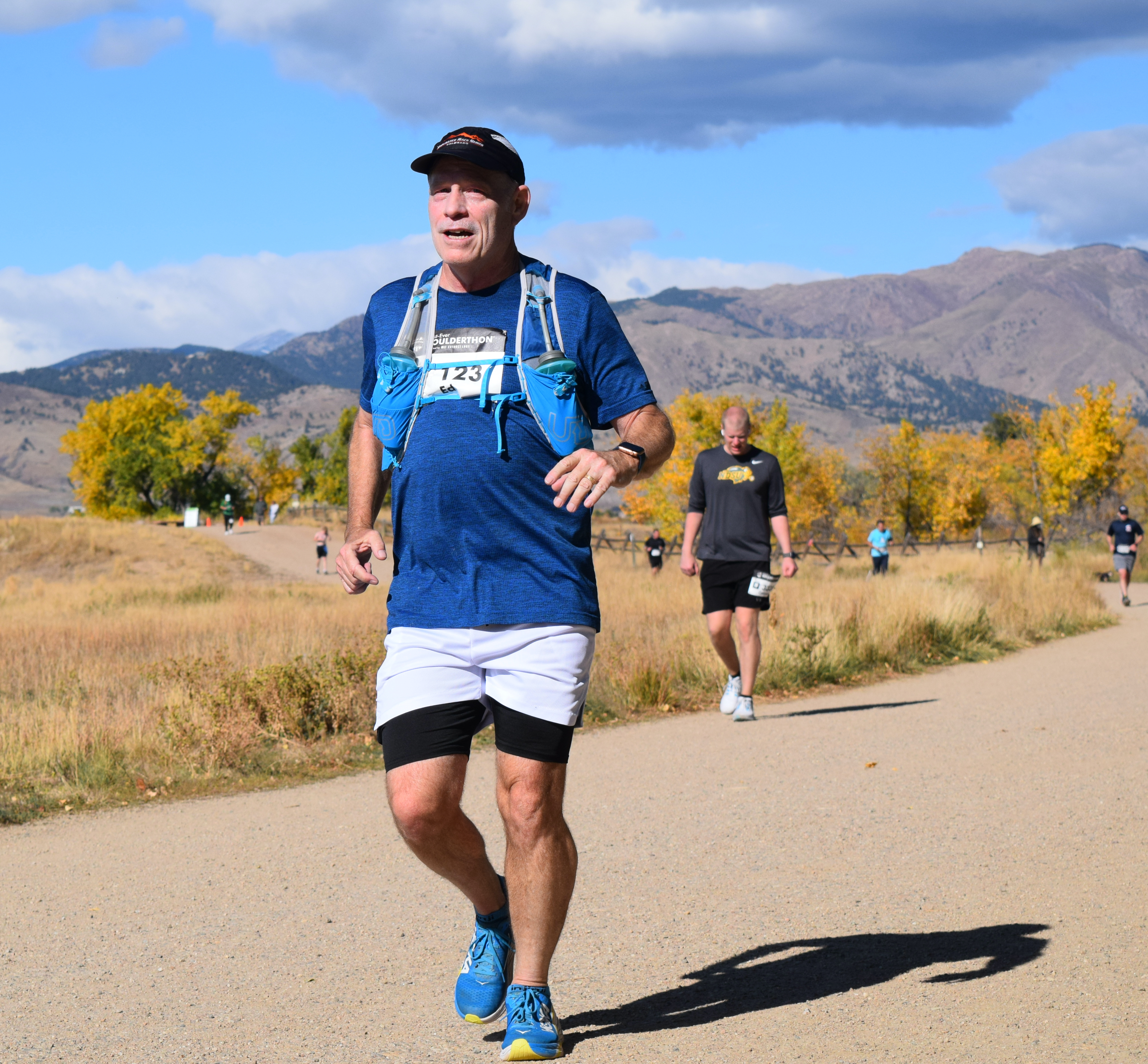
I ran the Boulder Marathon this morning. Four years after my last marathon. Not sure if I can explain why running 26 miles was important to me. Let’s just say 2020 was hard and I wasn’t happy with my weight gain. I wanted to be a runner again and running a marathon seemed like the best way to become one. That’s how runners think.
Same road as the first photo, Oxford Road, but headed back west at 11 miles
Although most of the race was run on the Boulder Backroads, as in past Boulder Marathons, this one finished downtown on Pearl Street, so the organizers branded it as the Boulderthon. Who am I to consider that kitschy? Well, I’m a product manager. I understand marketing, it’s one of the hats I wear more frequently at work. I’ve named my share of products. Given that the biggest draw of this event, per the race organizers, is the downtown finish on Pearl Street, I’d have named it the Pearl Street Marathon. Think Colfax. Think Peach Street. Something meaningful to the locals. That would have differentiated it from past Boulder Marathons. I shouldn’t complain though. The event could not have been more well run.
15 miles into it at Coot Lake
Karen and I spent the night at the Hotel Boulderado. There’s no parking at the race start at the Boulder Res, and I didn’t want to make her drop me off so early, plus the hotel is near the finish on the Pearl Street Mall. We enjoyed a nice dinner at the hotel restaurant, Spruce, Farm & Fish where I ate raw oysters and Cod. That thing about runners eating pasta before a marathon is a myth. There were also buses lined up near the hotel to ferry me to the race start in the morning.
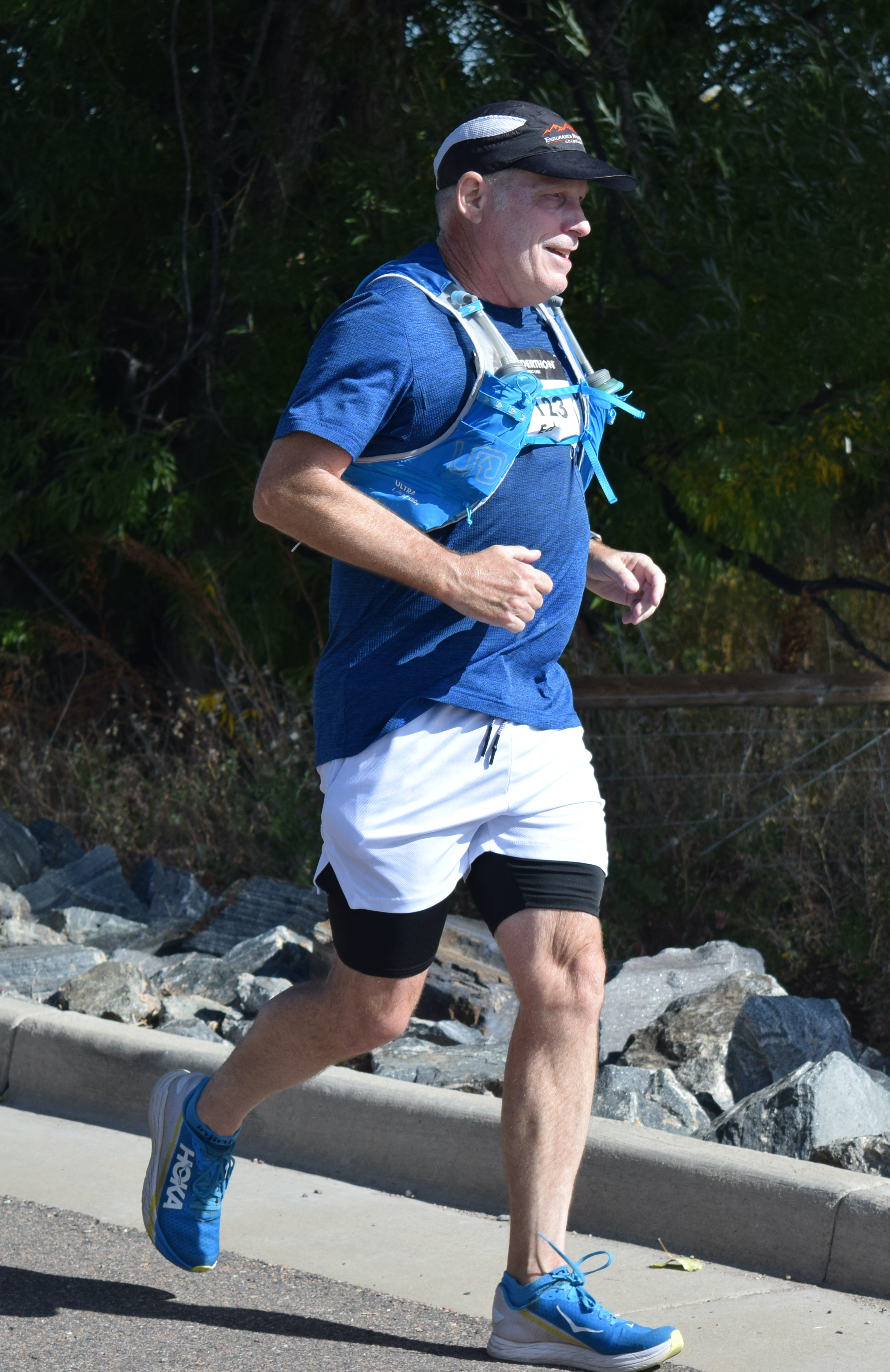
Beginning to slow down at 19 miles
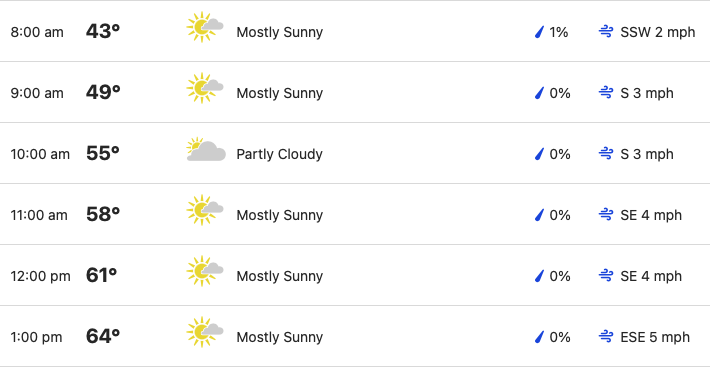
The weather was awesome and likely helped me to do better than expected. 43° at the start. Low 60s by the finish.
Nothing stretches distance out longer than straightness, and this course had some long, straight roads. The half-mile-long dam at the Res was the worst. Because it’s straight in every dimension, it felt like three miles. Oxford Road was about four miles of straightness, but at least it undulated vertically with some hills. Still, I felt really good the first half and didn’t start to feel fatigued until mile sixteen. I pretty much ran to the race plan I shared last weekend, except I ran a bit faster overall; 50 seconds per mile faster in the first half and 10 seconds faster per mile in the second half.
22 miles and still running
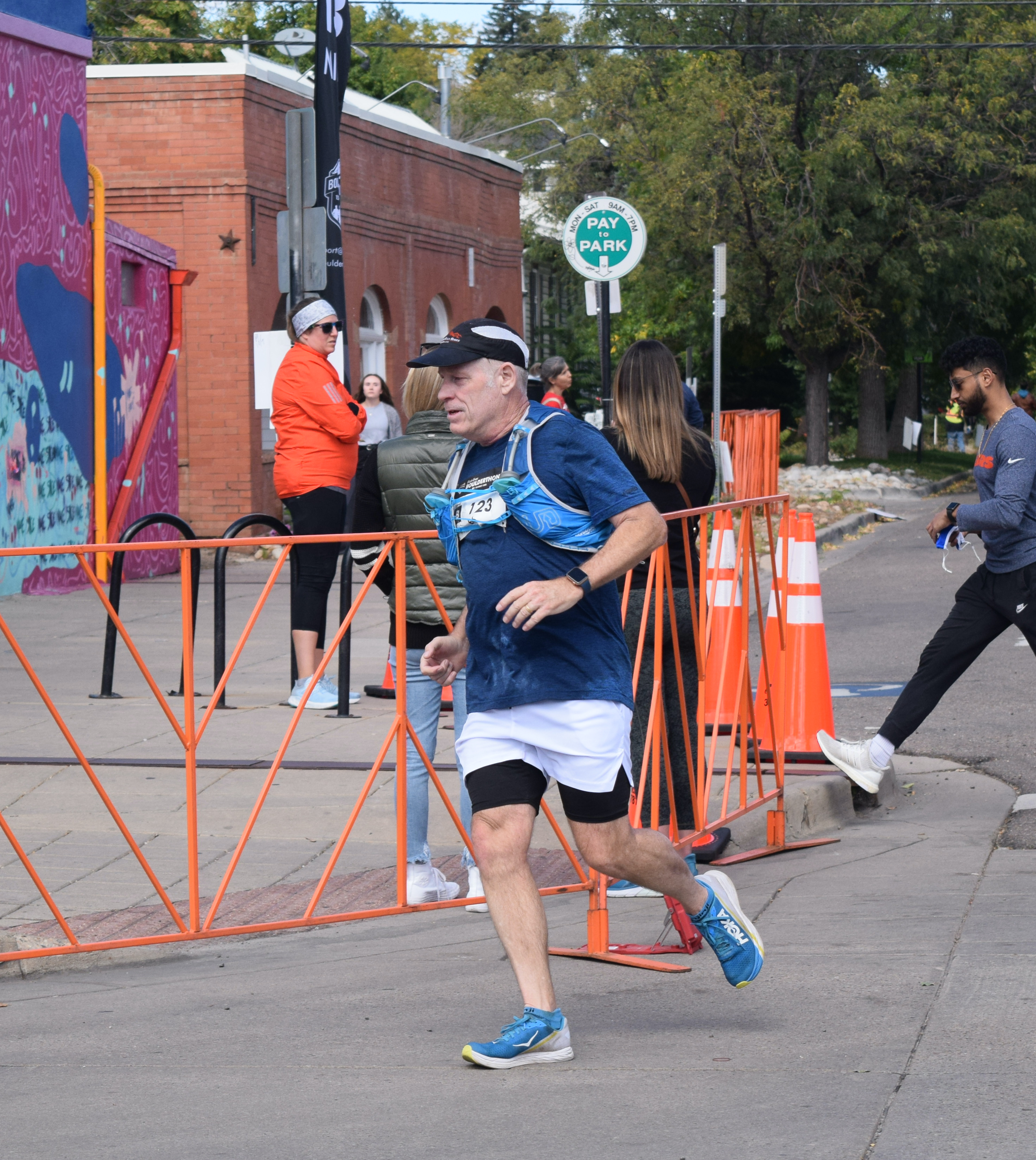
My breathing felt great this entire run. I never once felt like I wasn’t going to finish. I did start walking a bit at the aid stations to drink and douse my head with water in the final 10K. I also walked a tad whenever my heart would start to race past my max heart rate. I found I could recover after a half minute or so of walking. This was also in the final 10K. Still, I finished well ahead of my goal, in 4:35.
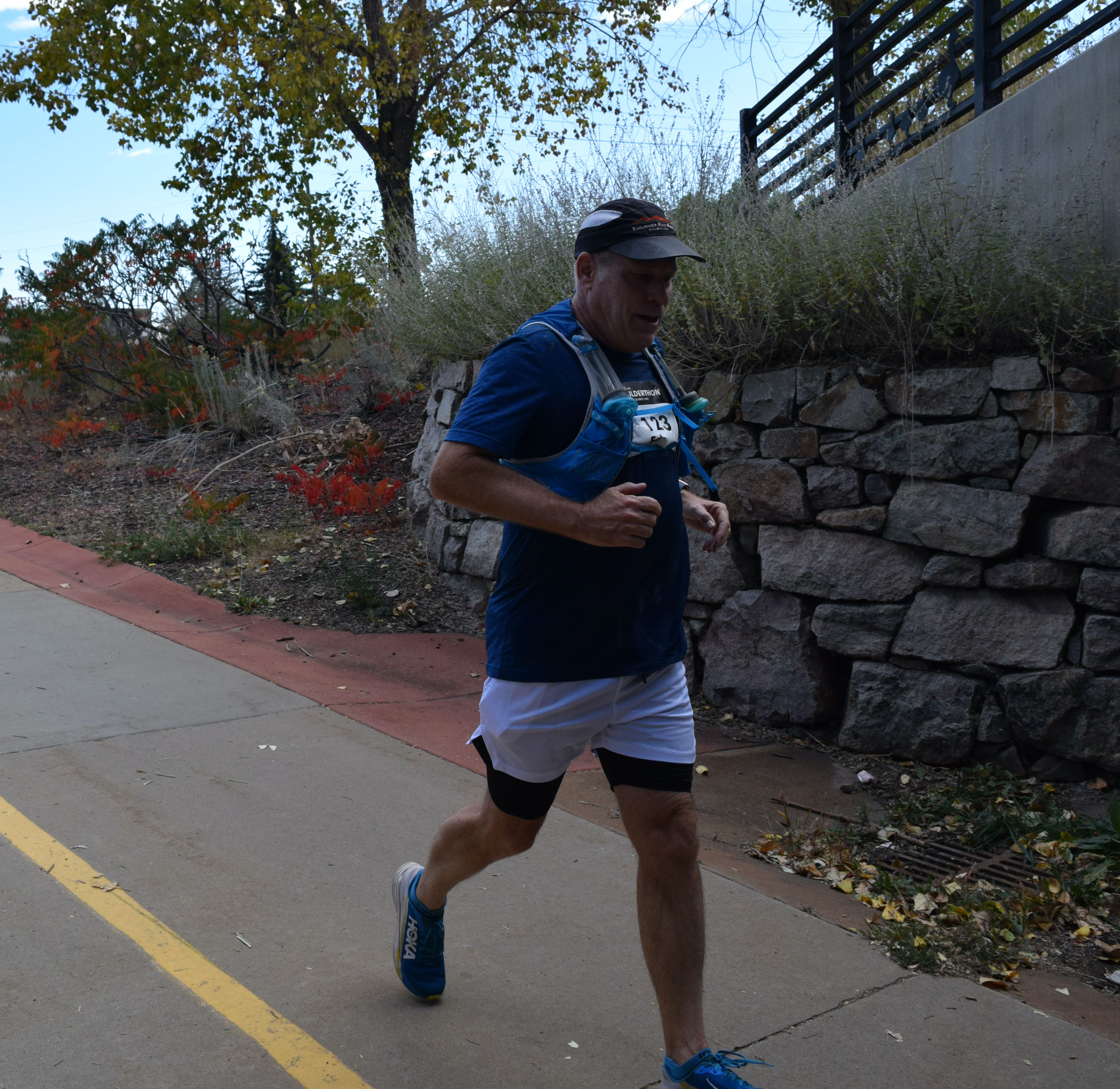
At 24 miles and ready for it to be over
My legs tightened up after twenty miles and shortened my stride, but I never came close to cramping. I helped a runner out at 23 miles by giving him the rest of my pickle juice when I discovered him on the side of the trail with cramps. I had two 17 ounce water bottles, one with Tailwind, a high-calorie sports drink that’s not at all sweet tasting, and the other with dill pickle juice. You won’t find a sports drink with anywhere near the sodium as pickle juice. It has more salt than the Dead Sea. But I drink it because it tastes good.
Turning onto Pearl Street at 26 miles
As usual, I found religion those final six miles. Because I didn’t want to disappoint God, I made promises I couldn’t keep with the Devil. I’m kidding of course, but man, the things you say to yourself to get across the finish line. The twenty-fifth mile was uphill with a quick downhill near the end. Colorado races will always throw a hill at you near the end. Race Directors are cruel.
The final kick
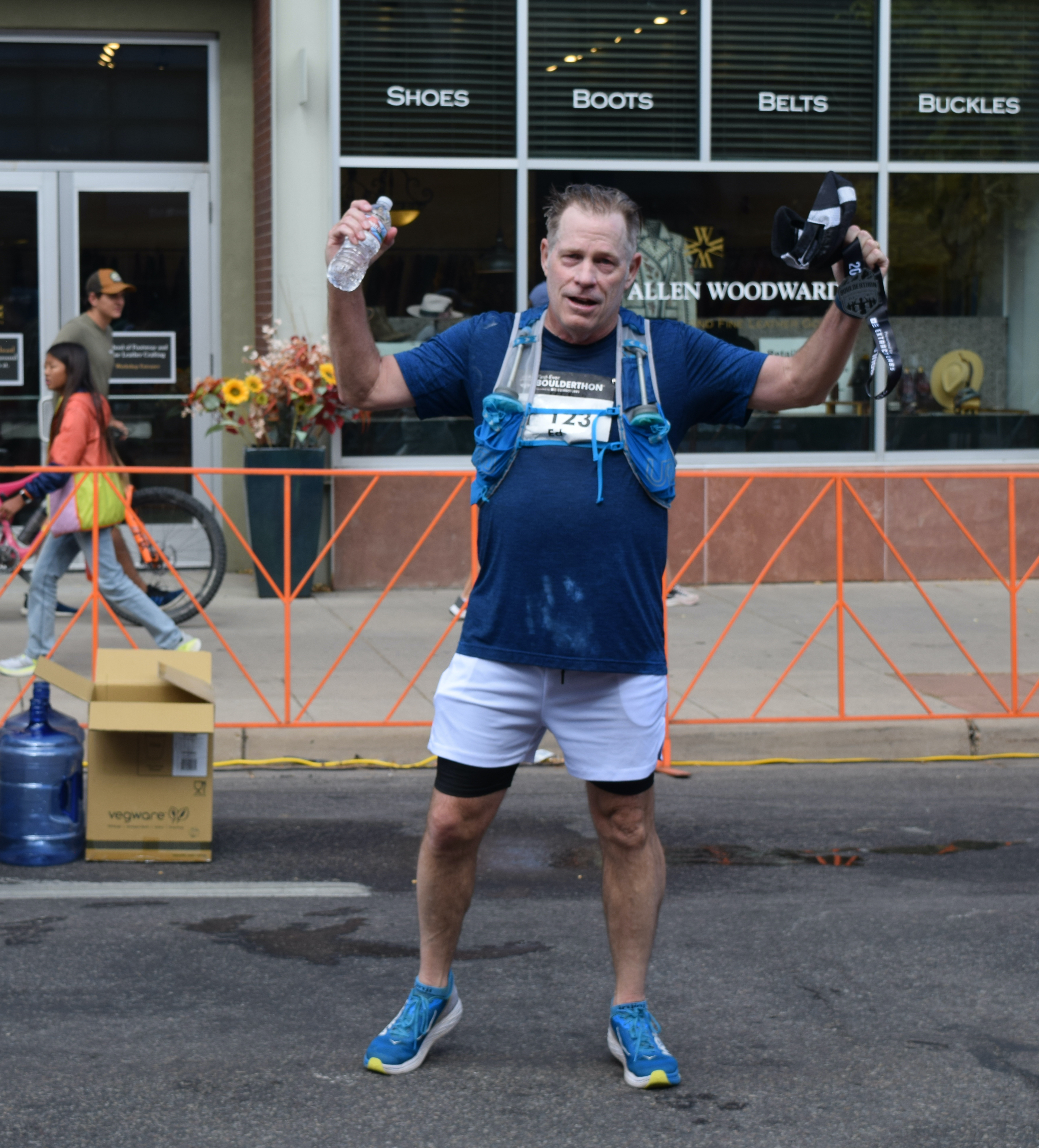
I wouldn’t say I put on a kick, but I did finish strong. Karen and friends were there at the finish. Chris Price served as my crew chief and took all these photos. He rode around the course on his bike, ready to resupply my sports drinks, or carry me off if I DNF’d.
My first marathon as a grandfather
Finished 5th in my age group, even though I was 4th and an hour quicker in my last Boulder Marathon. I think other competing marathons in October, or Covid, and maybe the poor air quality this summer, diluted this year’s competition. The first two weeks of my ten week training plan was inside on the elliptical to avoid the unhealthy air quality. I wasn’t as fit as I’d hoped to be for this event, but man, it felt good to run it. I’m a runner again.
Margot is starting to grow into her baby clothes, at least the legs, not so much the arms. Although I’m told she’s not happy being clothed. Like Matthew McConaughey playing bongos, she prefers her birthday suit. Who doesn’t?
I’m still committed to running a marathon next week. Given my condensed training schedule, rather than taper this weekend, I went for an 18 miler today. Nothing like a marathon on the calendar to scare yourself fit.
I wasn’t confident that ten weeks of training would prepare me to complete a twenty-six mile run, but I know I made progress toward improving my fitness and I feel so much more confident after completing 18 today. I could still drop out of the full marathon at the expo and sign up for the half marathon – a distance I could complete with much more certainty. But the deal isn’t about certainty. The deal is to try to run twenty-six miles.
That lack of certainty is partly why I enjoy running marathons. Even when I’ve been one hundred percent prepared to complete the distance, when the only question was how fast, marathons are never a sure thing. Although medically defined as obese, completing this marathon is as plausible as when I toed the starting line in competitive shape at my fourteen previous marathons. Anything can happen in a marathon over the course of three, four or five hours.
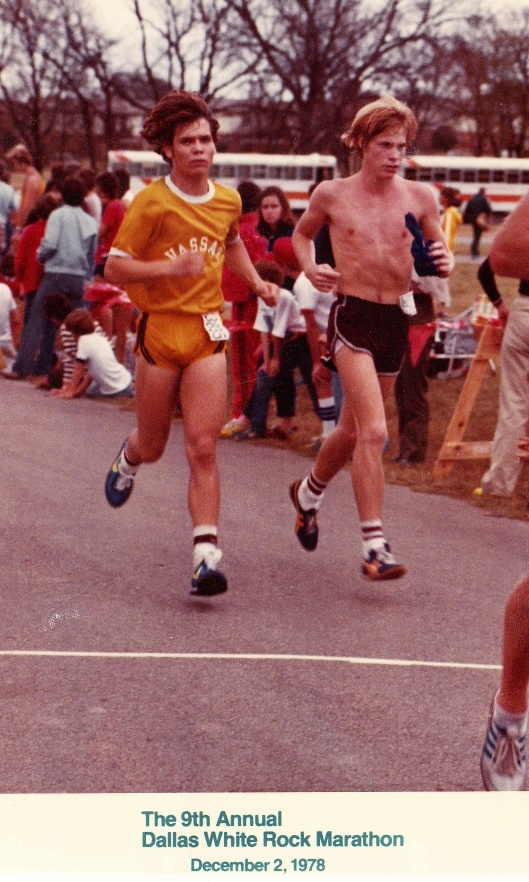
The two photos below are of me completing my first marathons at 16 and 18 years of age. I ran my first Dallas White Rock Marathon before watches had been invented, but I figure I might have run it in under four hours. Seriously, I think they didn’t post my time because in 1978 they didn’t have an age group for 16 year olds. I wasn’t supposed to be there.
Running my first marathon with high school buddy, Mike O’Neill
Running my second marathon with my college dorm mate, Johnny Martinez
It’s ridiculous for me to estimate what my pace will be without more running under my belt, but I did start wearing a watch a few weeks back and today’s 18 miler was good to set expectations – and I like to play this guessing game ahead of marathons. If I’m smart, I’ll start out behind the 5 hour pace sign and run a solid 11:30 pace the entire distance, speeding up slightly the final 10K if I feel strong.
If you know me, then you know I can be somewhat delusional about my prospects, so I’ll start out a bit too fast for myself. I suspect I’ll run the first 10K at a 10:30 pace, slow down to 11 minutes for the second 10K, and run the final half at around an 11:30 pace and finish at four hours and fifty minutes (4:50) – give or take fifteen minutes. I’m usually pretty good at these estimates, historically within about 15 minutes, with the exception of those four-hour-plus times listed above. Like I said, lots can go wrong in a marathon.
Two things generally lead me to catastrophic failure in a marathon. Heat and a calorie/electrolyte deficit, or you could say nutrition plan. The impact of either of those conditions might be mitigated if I went out slower. The result is generally the same, severe cramping in the final 10K that leads to walking a bit. Not overly concerned about the heat in October. Temperatures should range from 55° to 70° for my five hours under the sun. Might rain. Ideal running weather.
Maintaining form in that final 10K is so hard because of the nutritional math involved in running beyond three hours. It’s physically impossible to not fall into a calorie deficit after three hours. You’re burning calories faster than your stomach can digest new calories. You can drink sufficient electrolytes if you’re disciplined about it. Best you can do on calories is to get in enough very, very long runs (3 hours or so) as part of your training to teach your body to adapt to efficiently burn stored proteins and fats. Or run so fast that you finish under three hours. Before today, my longest training run was two hours and I’ve never run a marathon under three hours.
I’ve never had speed as a primary goal in a marathon. I got comfortable enough, and fit enough, that I was usually confident of finishing. My goals have always been around managing my calories and electrolytes so that I feel comfortable the entire distance. Running at a sustainable pace is part of that just as success in the nutrition plan leads to a faster time. This time around, simply completing the distance in under the six hour cutoff time is my only objective, but I still have to manage those other aspects of the race – pace, electrolytes and calories.
I’ll comment afterward on the viability of training for a marathon in only ten weeks in my post-race report. I lost zero weight the first four weeks, and dropped my attempt at dieting. I lost a few pounds after that, apparently it takes time for the metabolism to kick into gear. No where near my goal of twenty to twenty-five pounds, but I feel like I’m able to run this heavy after having sufficiently toned up. Planks and squats probably helped as much as running.
I don’t consider it a failure that I didn’t achieve my weight loss goal. I see it as I lost a few pounds. Likewise, I won’t be at all upset if I drop out before finishing. I know the odds are long. My goal was to try to run a marathon, so I’m going to try. You can track my progress at this site. My bib is 123. See you next week after twenty-six miles.
Yesterday was Brit’s due day. Not overly bummed that Margot Faye didn’t arrive on 911, but we’re on pins and needles. All I can do to pass the time is run. October 10th will be my first marathon as a grandfather, assuming I can get to where I need to be. I’ve worked my way up to running ten miles comfortably and I’m making progress learning how to best run over-weight, which is, wait for it, slow. Really, really, slow.
Speed is relative of course but my legs naturally fall into a nine and a half minute pace after they’ve warmed up. Problem is, I can’t sustain that pace for much more than ten kilometers. Running slower than your legs want to naturally go is harder than you might think. My cadence has been steady, regardless of distance, just over 170 strides per minute. Cadence is more of a cyclist term. Runners will instead refer to “pace” or “roll”, as in “I rolled past him.” But cadence is still a thing for runners, just as it is for cyclists.
If you’re running, as opposed to walking, then you’re very likely maintaining a cadence between 170 and 180 strides per minute, regardless of speed. If you’re running slower, say over a ten minute pace, then your cadence might be between 160 and 170, but for the most part, speed is determined by stride length while maintaining the same cadence. That might not be intuitive, but that’s how it works.
I’m finding it hard to run an eleven minute pace, I’ve been in the ten minute range. In the marathon itself though, I’ll simply line up behind the 5-hour pace sign. That will give me an 11:30 pace. If I feel good half way, I might run ahead of the pace sign at the Boulder Res. If I’m disciplined though, I’ll wait until about twenty miles, which is the start of a three mile down-slope segment. Slopes are noticeable at altitude.
I ran ten miles yesterday and was feeling strong enough to attempt twelve by running six miles before turning around. This part of my trail is actually a loop, or a lollipop as they say because it’s a five mile stick with a two mile loop. Problem was that the loop began an upslope. Gentle enough that you wouldn’t notice it at sea-level, but at a mile-high in elevation, it raced my heart up ten beats over my max rate for one and a half miles. I couldn’t recover by slowing down, which I did. It didn’t begin to drop again until the return where the slope began to drop.
The Boulder Marathon course will have a few tough slopes like that. Some that I would even call hills, although nothing terribly steep. It’s good to know that my heart rate will recover, I just have to hang in there and wait for the other side of the hill.
It occurs to me that I’m blogging more because of this marathon. Because I’m nervous. And that makes me think of what Brit is going through right now. She’s been pinging our family chat regularly with updates. She’s understandably nervous. My marathon is trivial compared to her life event. I recall how I felt decades ago. The anxiety was unlike anything I’ve ever gone through since. But then that baby is born and all is perfect.
That day is coming any minute now. The Rose Medical Center’s Covid rules are father +1, so Eric and Karen can be in the hospital. I’ll be a mile down the street in a Cherry Creek hotel. So excited to meet Margot Faye.
Sharing my stats is a clear sign I’m beginning to exhibit compulsive runner behavior, but it’s a runner’s blog, so there you go. Sharing my stats from today’s ten miler to illustrate how I’m going to use my heart rate monitor as my primary tool to get me to the finish line. Now that I’m tracking my stats, I’ve discovered that I have been starting to walk/run once my heart rate exceeds 160 beats per minute (BPM). That’s a function of my current fitness which I could no doubt exceed if I were twenty-five pounds lighter. In fact I have. Below are my stats from my last marathon four years ago.
You use the BPM tool like this. Subtract your age from 220 to know your max heart rate. Mine is 161. Four years ago, mine was 165. Experts say you should target running between 50% and 85% of your max heart rate. At 85%, that suggests I should run with my heart rate around 136, or four years ago, around 140.
During today’s run, I read my heart rate at 144 BPM just short of four miles. I purposely slowed myself down, by shortening my stride (my stats proved I maintained my cadence), and monitored it closely so that I didn’t reach 160. I was able to actually slow it down a couple of beats, although it crept back up to 151 by the end of the run. My experience was that I was able to comfortably run ten miles.
You might notice that my stats from the Colorado Marathon four years ago show I averaged more than 10 BPM over my max heart rate for the duration. Apparently, it’s not a sudden death limit as my max was over 200. Probably lucky to still be alive, but I was much more fit back then. You might also notice the Apple Watch graphing software really sort of sucked four years ago.
I’ll practice this more but I suspect if I can maintain a pace around eleven minutes per mile, I’ll be able to keep my heart rate below 150 and that will enable me to keep running. Maybe even below 140, which is what I should really target to avoid a heart attack. I’ve always enjoyed running without a watch, but I have to say, tech is cool.
The term delusional is often bandied about with a negative connotation. My run this morning forced me to consider for a moment that I might be delusional, thinking I can prepare for a marathon, grossly overweight with ten weeks of training. Fortunately, I’m not overly introspective and the moment passed. I don’t think considering reality is all that constructive while training.
I have up until the expo, the night before the marathon, to drop down to the half marathon and I’ll pivot to reality then. My thinking is that I’ve made good progress in the last five weeks and I have yet five more weeks.
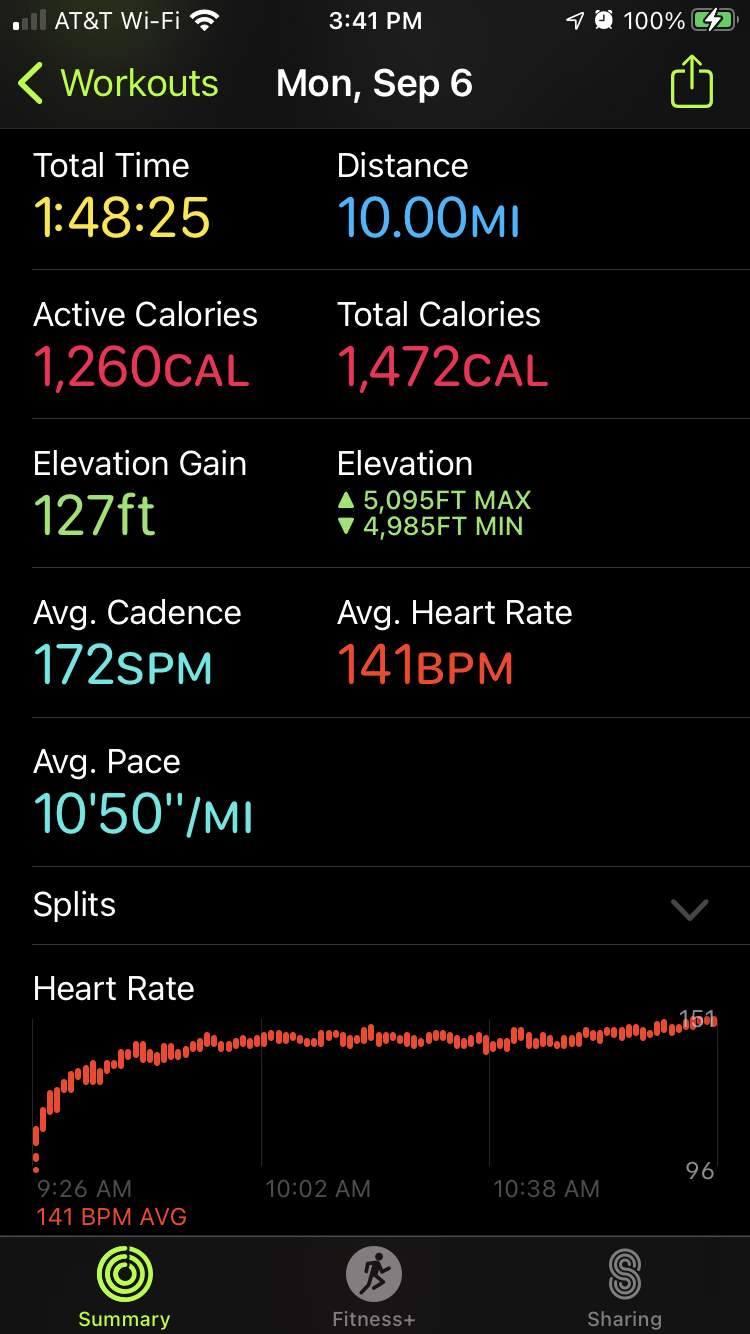
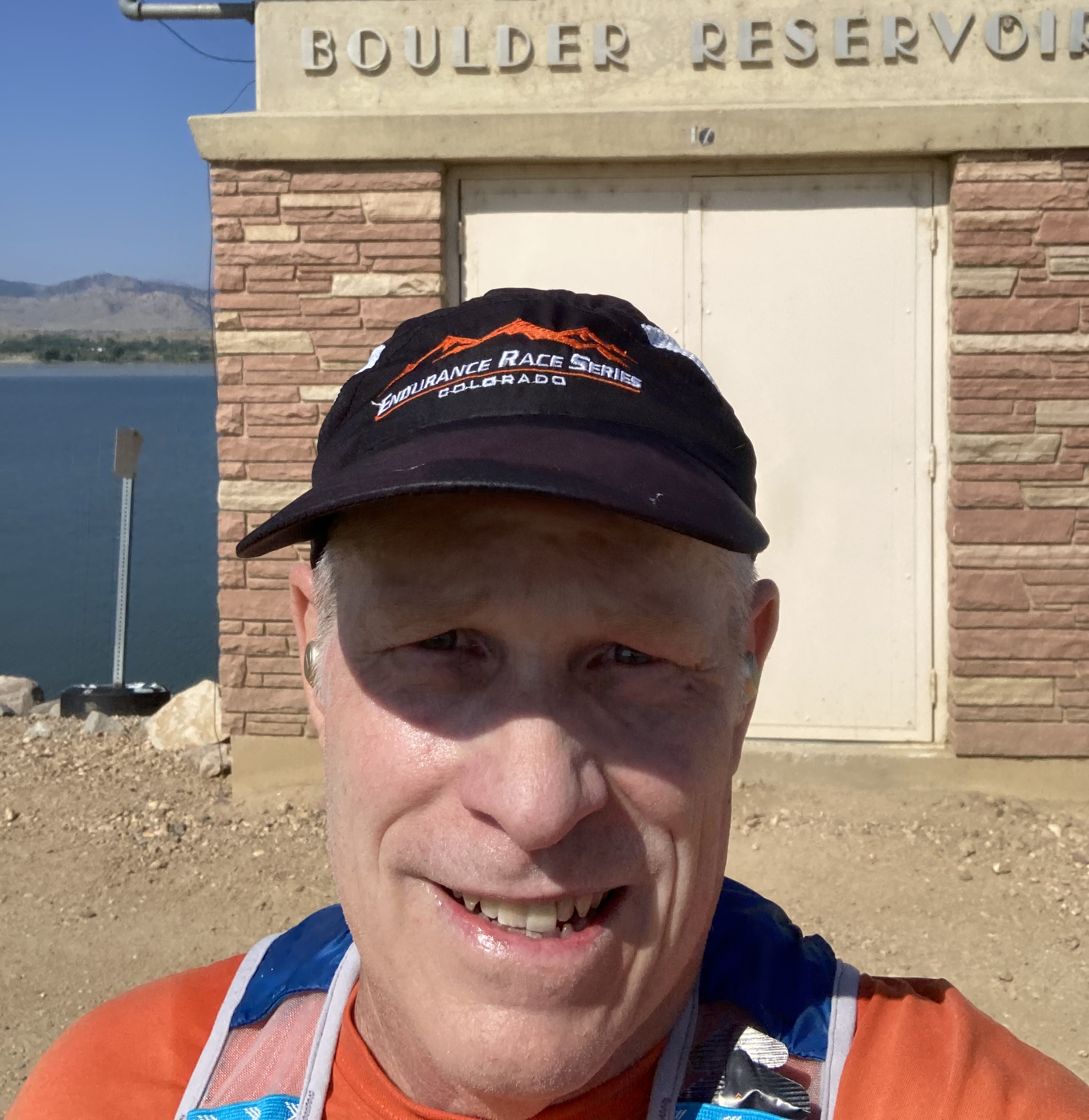
For today’s challenge, I parked at the Boulder Res and started my run exactly where the race is set to start. I had a number of objectives with this run. The first was to see if I could run the first sixteen miles of the course, which would loop me back around to my car. It’s sort of a commitment because if I couldn’t make it beyond eight miles, I would have an eight mile walk back to my car. That’s sort of what happened.
My second objective was to observe the accuracy of the course map. I can tell from looking at it that the final two miles along Magnolia and Pearl Streets are off by a half mile. I can now inform the race director that the first nine miles of the course map are off by a mile and a half, because my watch recorded eight miles where the map shows nine and a half. I made it to what I believe is the turn-around at Ouray and Oxford Roads and made it halfway back up the hill on Oxford before admitting I couldn’t make it to the top. This is where I began to walk.
With this, I’d met two objectives. I learned I can’t run sixteen miles and I proved the inaccuracy of the course map. All very good things to know. I wasn’t happy with having to walk so early, but the air quality wasn’t all that great, sixties when I left the house and nineties when I returned, and it set me up to test another one of my goals.
I wondered if, in the marathon, I ran the first half at around an eleven minute pace, could I walk/run the rest of the race and stay under the six hour completion threshold? Overall, I need to run a little under a 13:30 pace to remain eligible to finish before they reopen the streets. I think that will work because I ran a 10:27 pace before I started walking, and I maintained a 13:51 pace for the next six miles once I started walk/running. This also suggests I’ll benefit from running slower, at least an eleven minute pace.
Back to my second objective, the six miles of my walk/run back to the car accurately mapped to the course map. Hope the race director finds those observations useful. Because I’ve been pestering the race officials with everything from confirming my registration, to hotel discounts, to this map nonsense, I might use another email address going forward in case they’ve taken actions to block my other one.
The final useful objective was to learn that my shoes will work well on this course. I don’t know the percentage for the entire course, but the Boulder Backroads are over half gravel vs pavement. Some sections, like along the irrigation ditch, are brutal on the feet. At least, once your feet have become tender from having run so many miles. I recall my last Boulder marathon that was run as two loops around the Backroads and Res and hitting the irrigation ditch road was like walking on hot coals. I don’t normally like overly soft running shoes, or what runners call a high stack, but these Hoka Rockets performed. I couldn’t feel the gravel at all. Until I get some tougher feet, these shoes are what I need.
If I were to face reality, after today’s run, I’d drop down to the half, or perhaps from the race entirely. Instead, I’m still looking at this thing through Ted Lasso glasses and figure I learned a lot of good things from today’s poor run. I neglected to add that I nearly vomited afterward. Even though I carried and fully drank a liter of electrolytes, I ended the run dehydrated. Today was a tough run. Tomorrow is another day.