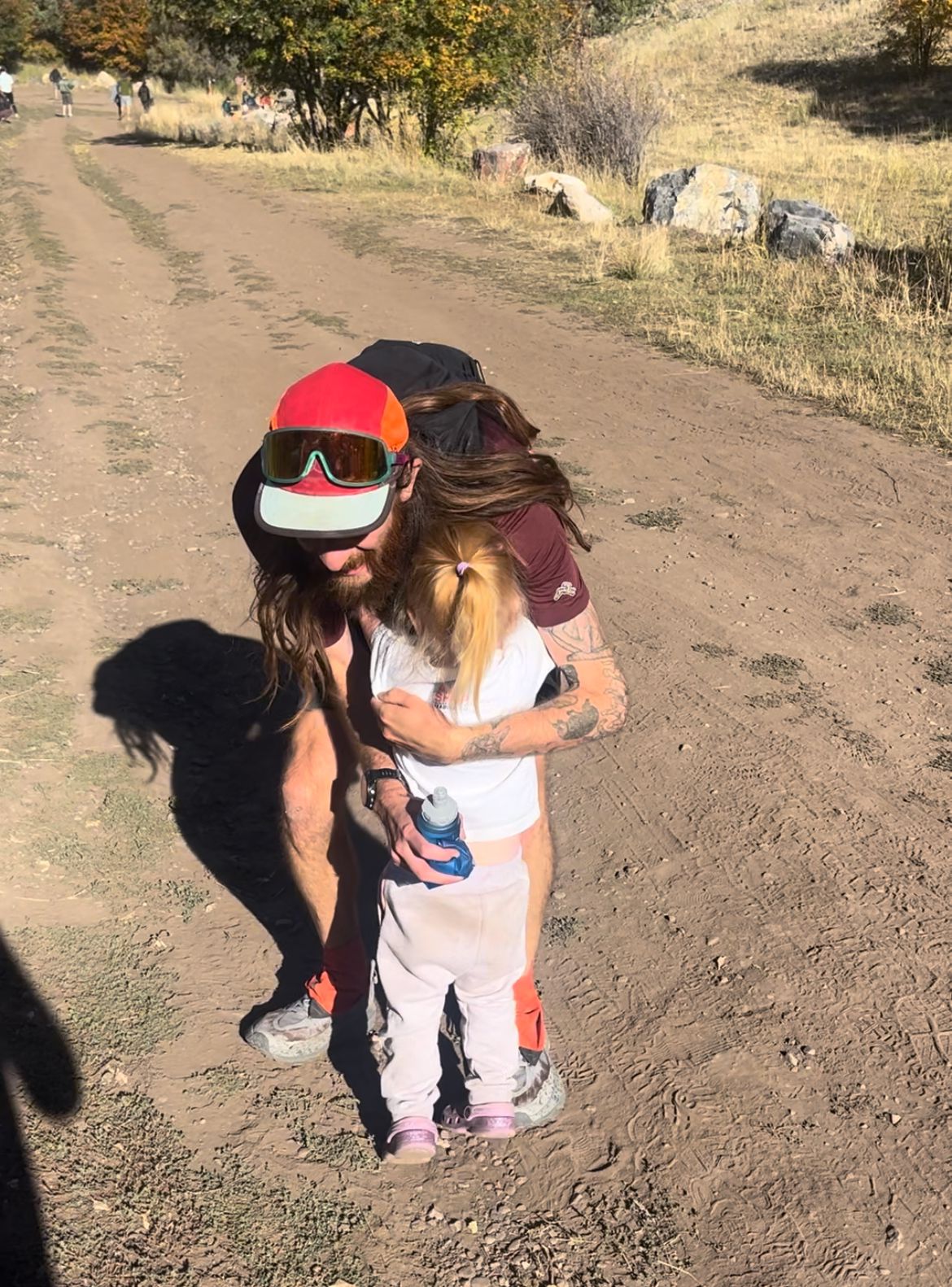
This photo is of my son-in-law Eric hugging my granddaughter Margot at one of the first aid stations in this weekend’s Bear 100 Miler. This is a big weekend for big runs. My buddies Keith and Bob ran a 50K ultra in BV today.
I’m pretty comfy now, sitting in my Boulderado Hotel king-sized bed, but at 7am tomorrow morning, I’ll be lined up to run 26.2 miles. It’s hard to sleep knowing that. I’m obsessing over the thought of pushing my pace. Going out fast hurts in the end. If I do, I probably won’t be able to hold the faster-than-I-can-really-run pace beyond the half-way point; so really, it starts hurting in the middle.
I ran both the 2023 Boulder Marathon and the 2024 Colorado Marathon at a 10 minute pace. I think I can do better. Maybe a 9 minute pace. That would give me a finish time under 4 hours. I’d be really happy with myself to run that fast. I do believe I can finish in 4:30, if all goes well, which would be about the same as my previous, recent marathons. So, 4:30 is my official projection, and 4 hours even is my dream goal that I’ll fall asleep thinking is possible.
If I’m bold, I’ll start out running with the 3:45 pace group. That’s a bit under a 9 minute per mile pace and would qualify me for Boston if I could hold it. I can’t. I could probably hold it for the first 10K, maybe even the first half. Then it will get hard. Really hard because that’s what starting out too fast does. I could start out slower and the entire run would be much more comfortable, but that won’t help me train for Bandera in January. Another strategy might be to ignore the pacers and simply queue up in the D corral, which is intended for anyone running a 9 minute pace. That’s likely what I’ll do.
I feel like accelerating my body’s demand for energy might help me to test my fueling and hydration plan for the Bandera 100K. Because an ultra assumes you got in the training miles and performance comes down to fueling and hydration. And the trail spirits being in your favor. This run is just a training run for the next one. This is how a runner thinks.
The wild card will be the heat. It’s going to be a bit warmer than earlier forecasts. Plus, I haven’t been training that fast. My training runs have been around a 10 minute pace. So one could say I’m a bit delusional, and I am. It’s part of what makes me a fiction writer. I do believe I’ll be safe being able to hydrate at the 16 aid stations that carry Mortal Hydration Mango and don’t plan to carry water bottles. I plan to carry a half dozen salt chews, but the aid stations will also have SIS Beta gels which I’ll be fueling on in Bandera, so perfect practice. This marathon has the most abundant and well-stocked aid stations I’ve ever seen. I plan to take full advantage of that. Being able to stomach all the fuel and hydration is perhaps another wild card. There are porta-potties at every aid station.
You can track me here starting at 7am, Sunday morning.
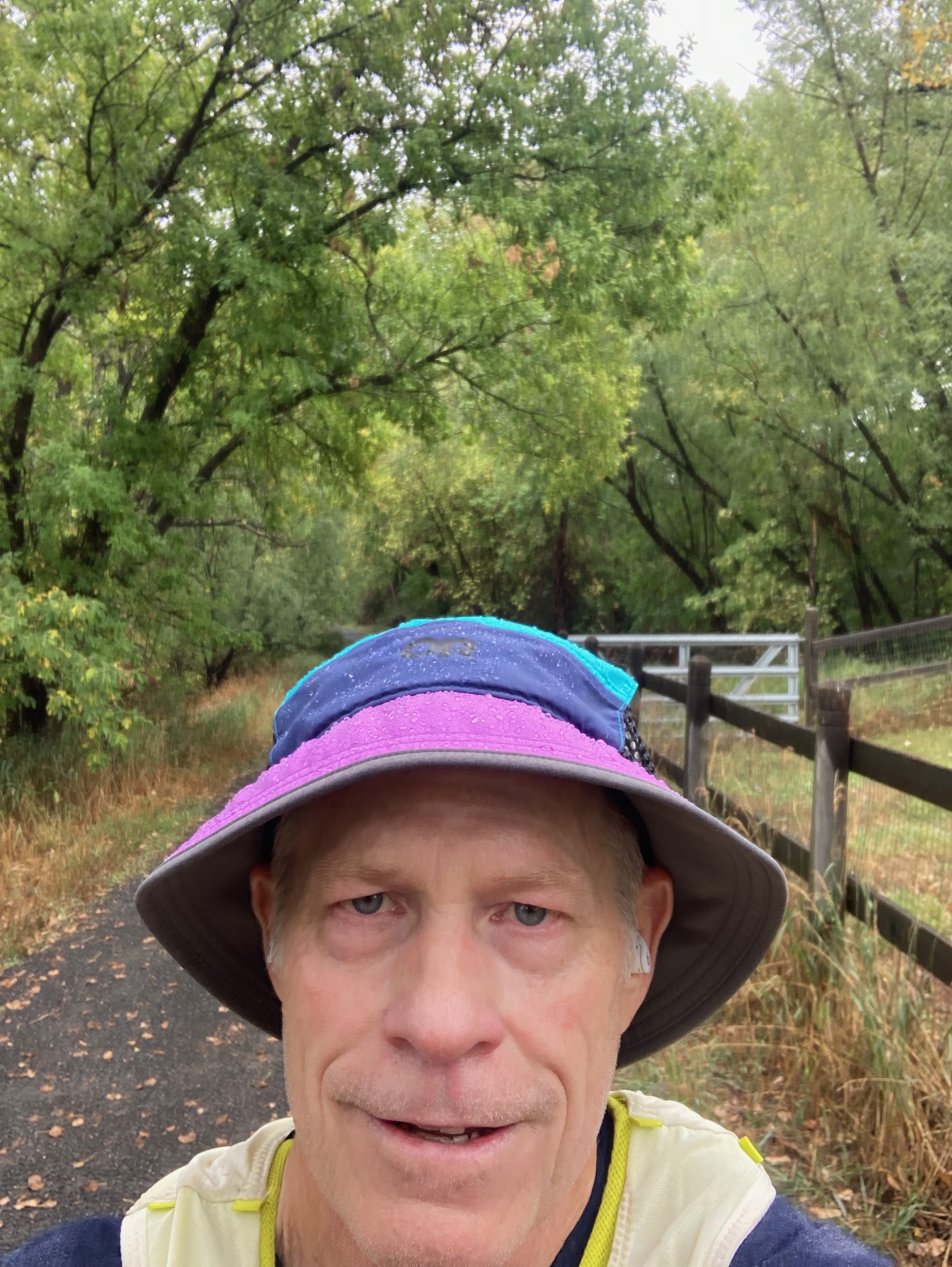
I have a new running hat – the bucket hat style of serious ultra runners. This hat alone makes me an ultra runner. The bucket hat style is brilliant, and this REI version of it worked out well in the rain this morning. I’m a happy camper. I’ll be wearing it for next Sunday’s Boulder Marathon. You can track me here, starting at 7am Mountain.
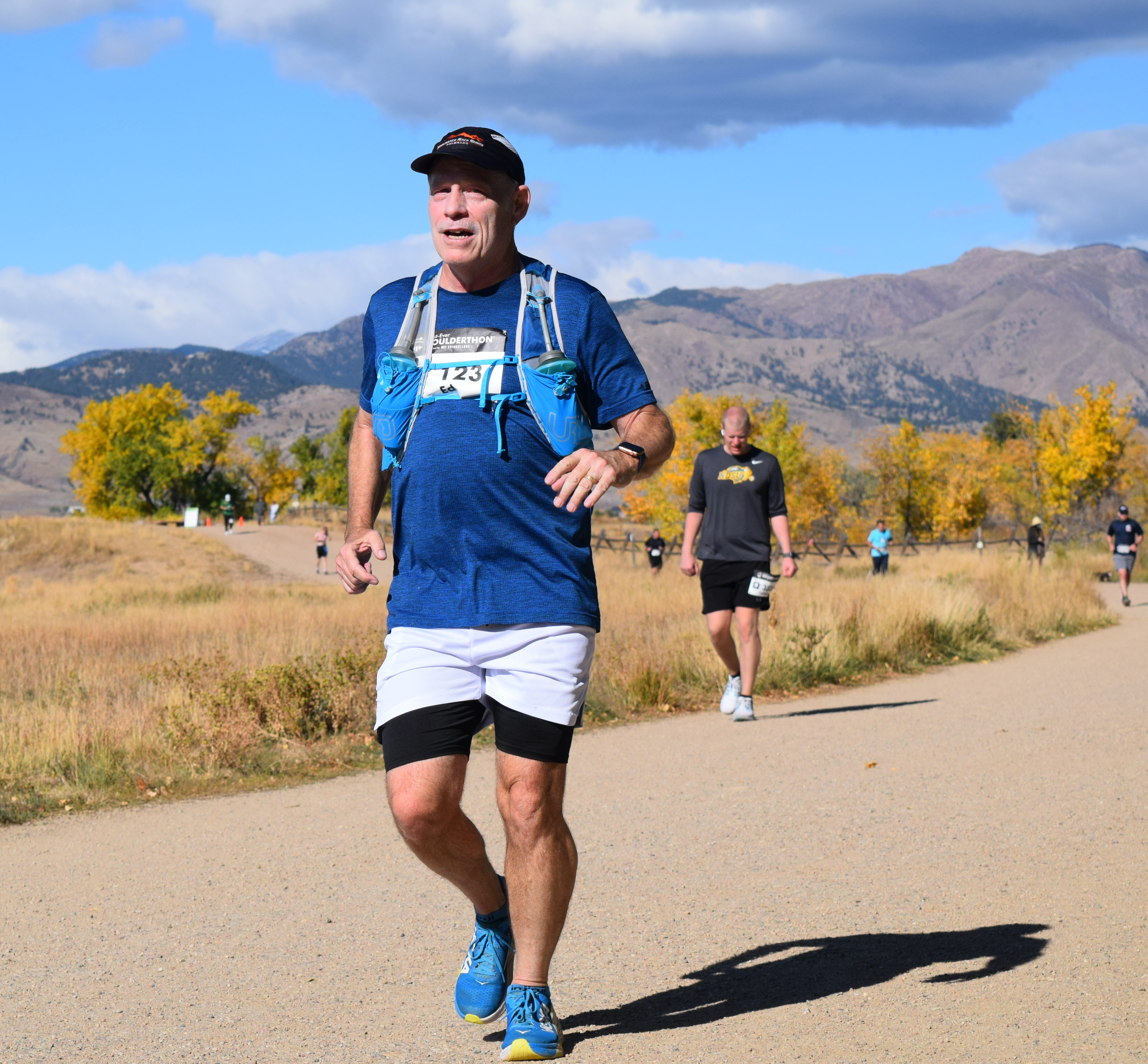
You can tell it’s fall in these photos. Some trees are turning color and the air was 49° as I launched into my 16 miler this morning.
The cool temps helped me average a 10 minute pace. I’m hoping to run a bit faster than that in the Boulder Marathon. If my son-in-law Eric has a strong performance at the Bear 100 Miler on Friday, that’ll put some pressure on me to do well. You can track Eric here on Friday.
The other reason you know it’s fall is because Margo turned 3 on Saturday. Her birthday always marks the end of summer.
I should practice wearing my running vest in races leading up to the Bandera 100K, but I’m nothing if not a pragmatist. The 2024 Boulder Marathon has aid stations every two miles and they are stocked with really, really quality gels and hydration. A rarity. And I wear my vest plenty on my long weekend runs.
So I’m going to enjoy running naked. I’ll eat the SIS Beta Fuel gels and drink the Mortal Hydration mango electrolytes at each aid station. My fueling plan is below. Each aid station cup is about 150 ml but I’ll plan on getting an even 100 ml out of them. The water bottles in my vest are 500ml. I’ll target drinking two cups at each aid station.
Aid Station Miles – Boulderthon
ml
Carbs – grams
Calories
Sodium – mg
Potassium – mg
Magnesium – mg
Calcium – mg
SIS Beta Fuel Gel carbs
SaltChew sodium
2.4
200
4
18
180
60
10
8
4.2
200
4
18
180
60
10
8
6
200
4
18
180
60
10
8
80
2
7.6
200
4
18
180
60
10
8
8.6
200
4
18
180
60
10
8
10.2
200
4
18
180
60
10
8
12.3
200
4
18
180
60
10
8
13.4
200
4
18
180
60
10
8
80
2
14.4
200
4
18
180
60
10
8
16.2
200
4
18
180
60
10
8
17
200
4
18
180
60
10
8
18.4
200
4
18
180
60
10
8
20.4
200
4
18
180
60
10
8
80
2
22
200
4
18
180
60
10
8
23.7
200
4
18
180
60
10
8
25.3
200
4
18
180
60
10
8
3200
64
288
2880
960
160
128
240
6
It’s just so unusual for a race to offer such quality fuel. And SIS Beta gels are one of the gels I plan to consume at Bandera, so while I’m not practicing wearing my vest, I’m still eating the gels I need to test out. Not sure if I’ll drink Mortal Hydration, but this marathon will be the perfect opportunity to test that out as well.
The thought occurred to me while running over the brutal cement in the final 10K of the Boulder Marathon that there was no way I could run the Bandera 100K ultra. This marathon was partly intended as a stepping stone to committing to that ultra. Distance running at that magnitude is a confidence game. But pain and doubt have a way of fading over time; in this case, a couple of days, and I’m already strategerizing on how I might complete a 62 mile run in the Texas Hill Country. I’m reviewing my lessons learned. My focus has shifted from the lows I felt on that concrete to how well I ran. This is a list of my green lights.
I ran about five minutes faster than I did two years earlier, on what I believe was a tougher course. I was also about five pounds lighter I think, 185 pounds vs 190. Weight is everything in distance running. I’d want to continue to lose weight. I’d be confident in January at 175 pounds. Historically, in my older years, I’m pretty competitive at that weight. At 165, which I was for a good three or so years in my fifties, I’m on the podium in everything from a 5K to an ultra. I don’t care to drop to 165 again though because it makes me look too much like a skinny runner.
And speed is the first thing I need to get over as I train for a 100K. I think I have. I’m really comfortable and happy with my slower pace. I need to run slower yet, I need to learn how to run a 15 minute mile pace. The trick is probably running whatever pace I’m comfortable at, say 11 minutes, and then add in some walking. My fitness instructor buddy Rob suggested that approach to me. I’ll figure that out this fall.
Next is gear. I could spend all my time thinking about the right gear. Gear is fun. Between my recent backpacking and this marathon, I have a number of lessons learned. I know the socks I’m going to wear. Alpaca wool. I backpacked five days nonstop in the same pair of socks and my feet stayed dry.
And I’ve discovered a gel I can stomach. Science in Sport – SIS. It has a good amount of liquid and is almost palatable. This came to me from my ultra running son-in-law. I’m not certain I’ve settled on an electrolyte drink, I used Maurten for this event and I’m not 100% on it. I’ll be good with the Scratch served at the aid stations, I have experience with that sports drink. I might use what I carried during the marathon. I did have some slight stomach pain and I wasn’t big on the flavor. I really like my Cure, it tastes so good but it doesn’t have enough calories or electrolytes for an ultra.
I bought some SaltStick FastChews (salt tablets) that I’ll begin to train with on long runs. It’s difficult to gauge how much you sweat in Colorado. We sweat in Colorado, but it’s a dry sweat. Ultra runners get pretty scientific about it. They want to know how much salt they sweat in addition to how much they sweat. I’ll try to figure out how much salt to consume based on what amount keeps me from cramping. My muscles did fine in the marathon so I did well on electrolytes. I credit the pickle juice.
I’ve gained a sense of my pace. To my surprise, I’m pretty comfortable running a 9 minute pace, but only for a half marathon. This marathon would have been easier had I maintained a flat 10 minute pace, which was my overall pace. I want to break 17 hours in Bandara and I can do that with a 16 minute pace – over hills and rocks and hours – but still, seems like it might be in my wheel house by walking enough, well before I even need to.
I believe I’ve found the running shorts that will work. They’re essentially short tights. A TrackSmith brand that didn’t even hint at chafing. I’ll need to buy a rain jacket. Sort of learned that backpacking. Interestingly, this was the very first time I wore my bib on my shorts. I studied photos of ultra runners and they all wear their bibs on their shorts. I suspect so that they can change their shirts. I’ll be sweating in Texas, even in January with that humidity, so changing shirts often is part of my plan. I changed out from a t-shirt to a tank top half way through this marathon and it made a big difference in my comfort.
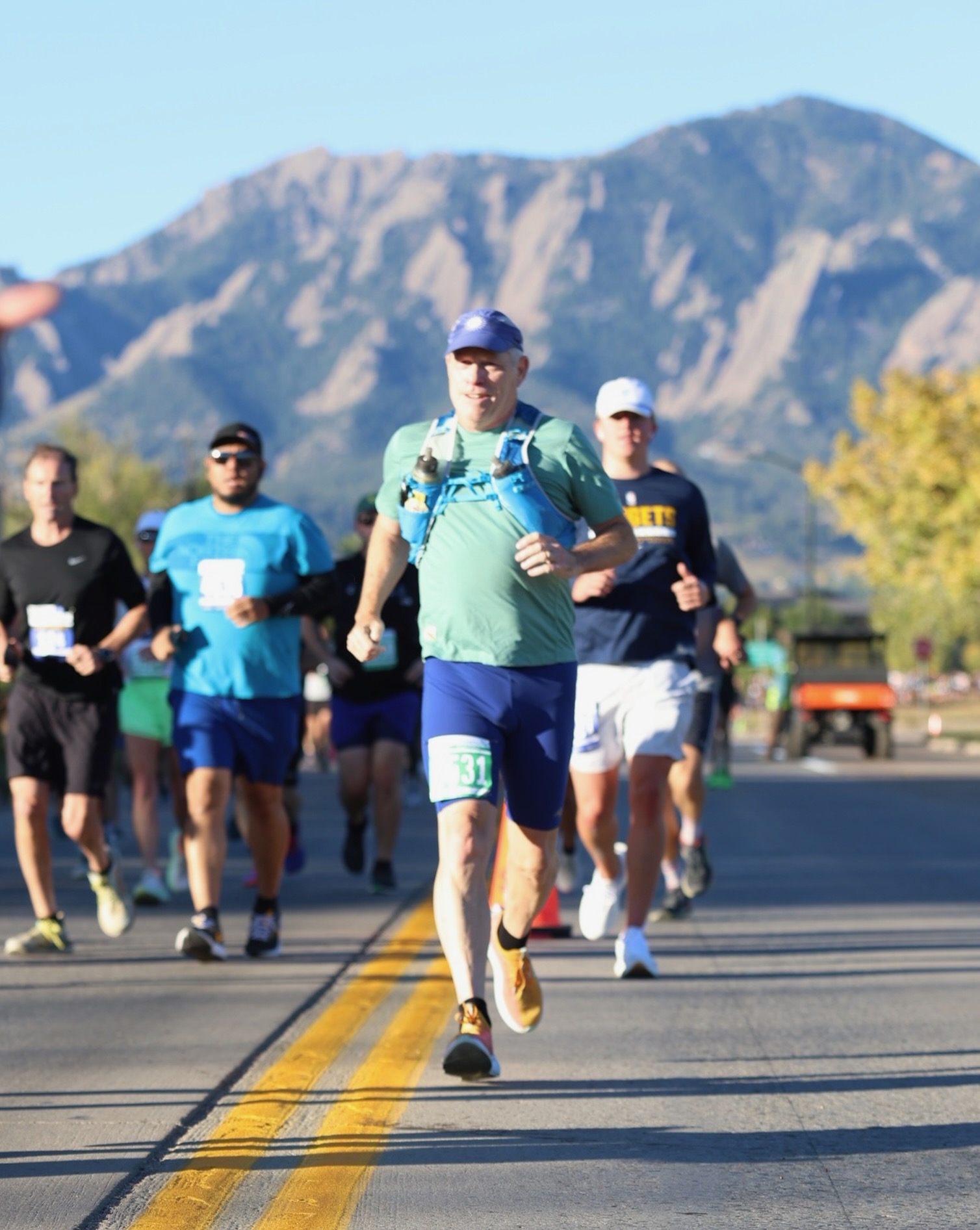
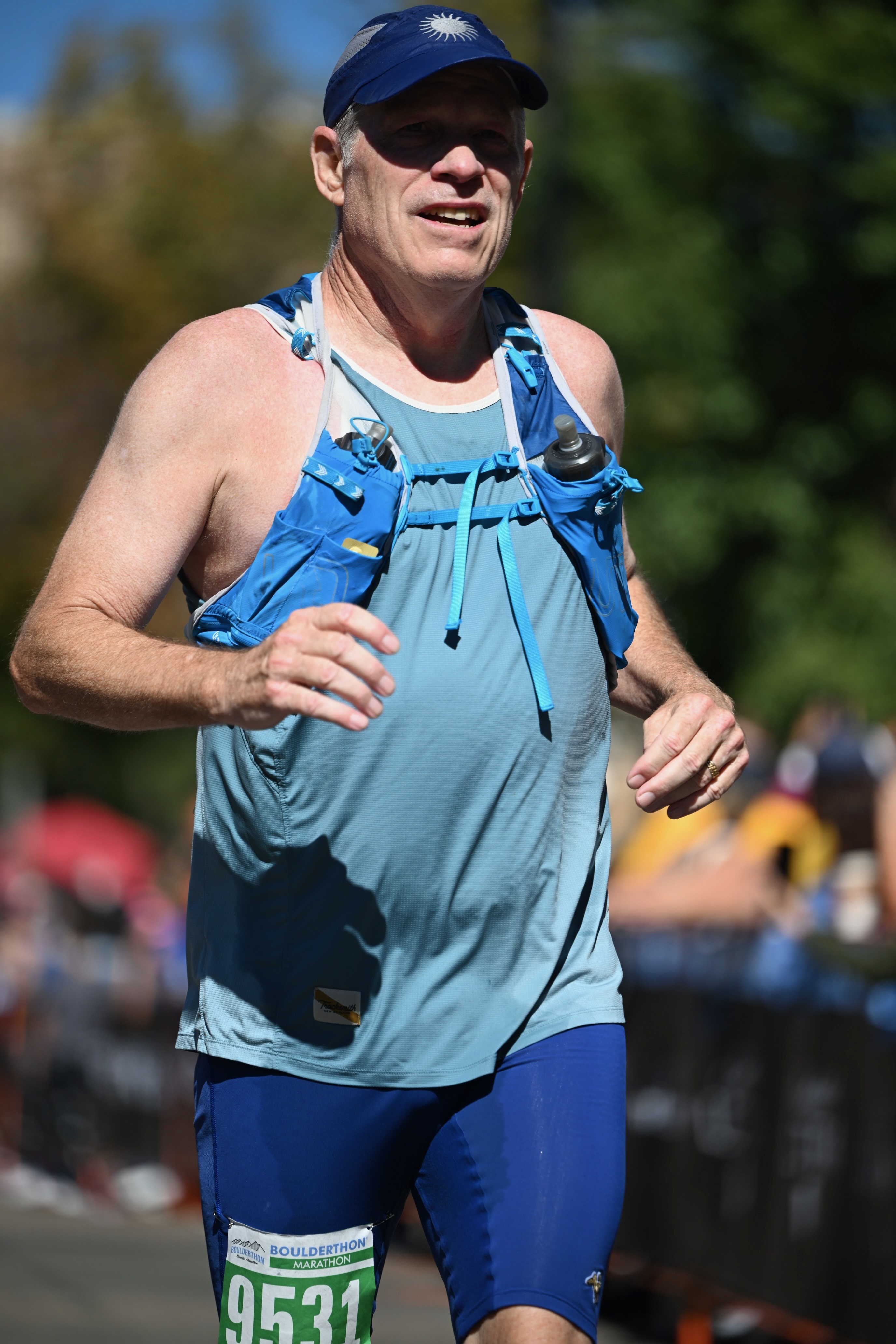
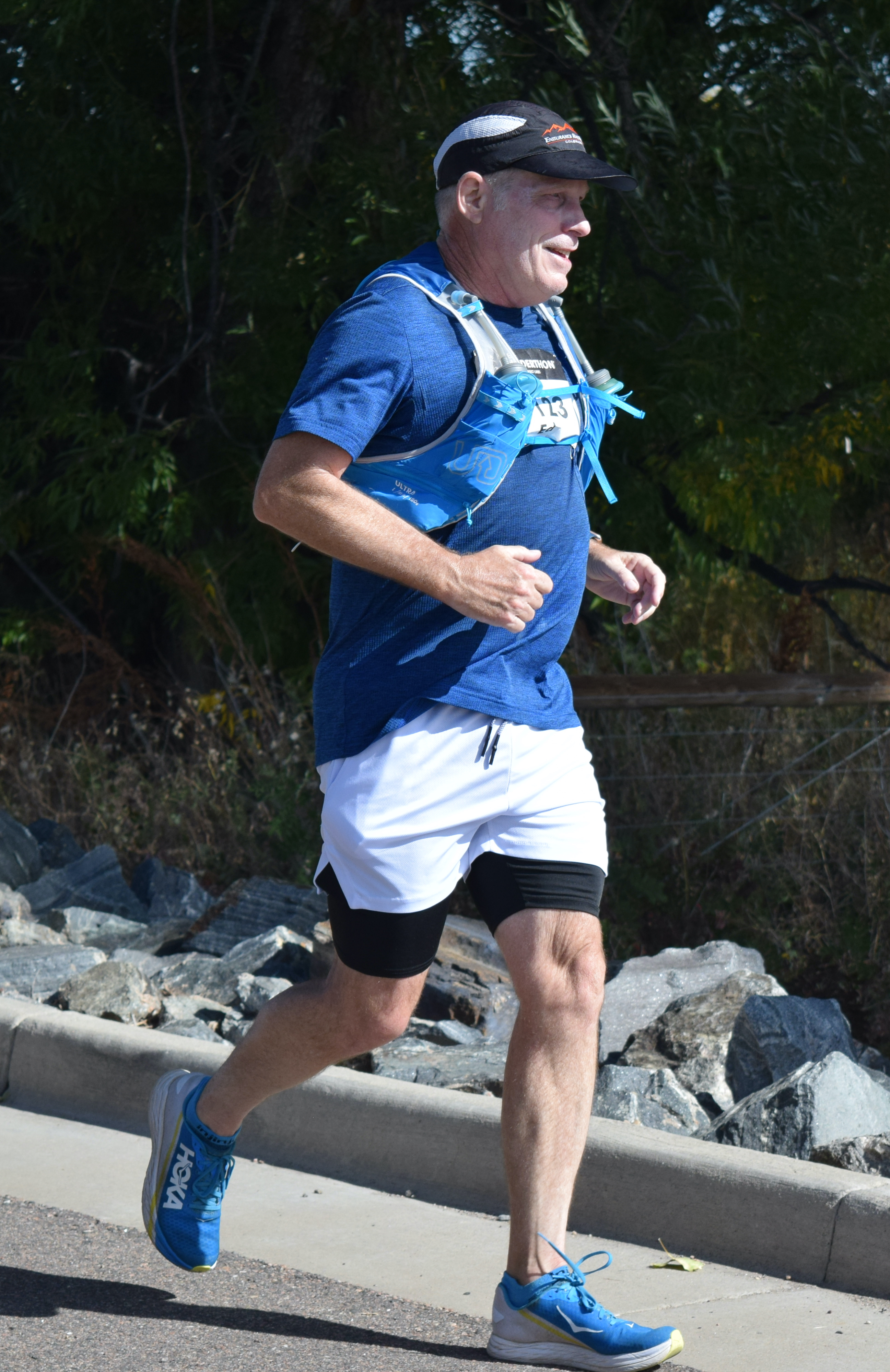
I learned that I absolutely hate my hydration vest. Gels fell out. Not enough pockets or big enough pockets. These photos show how I twisted one of the shoulder straps without knowing it. Likely when I took it off to change shirts. So, this is not a green light, and if I’m honest, it contributed to me also failing at consuming enough gels. I’m tempted to not even wear a vest. Again, studying photos of the runners at Bandera, it appeared the elites didn’t wear vests. Many wore waist packs but the aid stations are so close that they’re optional. I figure I will wear one to store a rain jacket, if the weather suggests rain, and other emergency gear, but it’s something I’m still considering. Either way, I’m buying a new one. At races where aid stations are so plentiful, I suspect it still pays to carry gels with you in order to consume them at a slower pace.
The final topic area I needed to monitor was my atrial fibrillation. I think it kicked in twice. Without my heart monitor or Apple Watch, it’s hard to know but I found myself walking twice and unable to easily catch my breath. That’s a good indicator. I just had a heart monitor patched onto my chest yesterday that I’ll wear for two weeks. The results will be helpful and should lead to a dialog with my doctor. I’ll bring up the ultra and see what he says. I don’t expect it to be an issue but I don’t really know. Time will tell.
Before I could run this morning’s marathon, I had to attend Rachel and Aaron’s wedding in a Denver brewpub last night, replete with food truck. It was great. Rachel is Brit’s good friend that sings with her in GirlfriendCult. Margot enjoyed the wedding too. She got the flower headband from Rachel’s childhood friend Audrey who’s been helping out over in Ukraine – so you get the colors.
This year’s course was difficult. A lot of hills in Niwot and a good measure of concrete sidewalks on the return through Boulder. Concrete’s fine if you train on it. I tend to run trails. Karen wanted a photo of my shoes to thank Brit and Eric for gifting them to me a year ago. Those Hoka’s came in handy to cushion the cement.
The run felt much warmer than the 40s, 50s and 60s it was supposed to be. Perhaps the full sun and zero wind. Smartly, I carried a tank with me in my hydration pack and put it on a little over halfway. That might have saved me. I also did a good job hydrating, including 500ml of dill pickle juice. I shared some with another runner who was cramping. I felt comfortable most of the course, until the final 10K where the wheels typically start to fall off. Averaged a 10 minute mile pace though overall, good enough for a second place water bottle award for my age division. Today was tough enough that I’m rethinking that Bandera 100K in January, but still, it was a good run.
I have to add, I blogged last night that I expected to run a 4:30 to 4:45 total time. Without wearing a watch, I crossed the finish line in 4:30:59.
I was disappointed I couldn’t run last year’s Boulder Marathon. I thought I could do it and I wanted to start out my sixties by running a marathon. I ran two in my second decade of life, there’s a gap, then a dozen or so in my 40s and 50s. There’s a gap again. Shorter this time. And now. I’m confident enough to project a finish time between 4:30 and 4:45.
The important thing about that time range is its specificity. That’s how good I am at these projections. Anything outside that range should make for more interesting stories.
I’ve been told I go out too fast – an understatement for just how spectacularly bad a few of my marathons have gone – but most of them go okay. The people who say that haven’t seen all the good ones. I think I’ll run fine.
I need to do well because this is a warmup for a pending ultra. I’ll waterboard myself in hydration and electrolytes. I’ll wear a vest to prep even though I doubt I’ll need one, It has great aid stations. I’ll consume ungodly gels; not to get to the end of twenty-six miles, but to prep for what it’s like to eat that shit over sixty-two miles.
Like last month’s backpacking, this Sunday is all prep. My pace is noticeably slower than it was a few years ago, like in 2015, when I cranked out 8 minute miles for the full marathon on the Boulder Backroads. I like to predict my pace ahead of time and am usually spot on. I haven’t been wearing a watch much this year, but I’m getting a sense of my pace. This course reminds me of the Austin Marathon – there’s a hilly section around mile ten.
Yesterday, I completed week one of yet another ten week plan to prep for the Boulder Marathon. I’ve been down this road before. Seems like just last year I trained for this marathon with only ten weeks of running. There’s more riding on this one though. This time around, I’ll be running a marathon at sixty years of age.
Like last year, I’m not starting completely out-of-shape. Last year I’d been running weekends. This year, I’ve gone a full month without running, but I squeezed in some good hiking in July. Those four days of backpacking with Rob in the Mount Zirkel Widlerness Area set me up directionally for marathon training. I’ve lost three pounds since that hike. So, I feel like I have a leg up on these ten weeks.
I setup a mileage plan. Not overly aggressive, I won’t strive for over seventy miles in a single week. And really, I doubt I’ll run more than fifty. The primary goal though starting out is consistency. I targeted thirty-five miles this first week, and next, but the bigger goal was to run every day. I hit thirty-four miles. Close enough. I ran all seven days and that’s the victory I’m taking out of week one.
One particular run, Tuesday I think, felt pretty good because the weather was a bit cooler. Several of the runs have seriously sucked. Saturday was one of those. It was also my longest run at seven miles, but I walked a bit in every one of those miles. Not sure why. Could have been heat and humidity. Maybe I didn’t recover fully from Friday’s late afternoon run. My heart kept racing to over 170 beats per minute and I just had to stop running.
I developed a pattern of running for two or three telephone poles and then walking one. I relabelled my run an interval workout. If you’re going to establish hard-to-reach goals for yourself, you need a few tricks like that. I don’t have a coach looking over my shoulder so I take some liberties. I’m trying not to get too psyched out about not being able to control my heart rate. It felt horrible though. At around 170 bpm, my legs forced themselves to walk. Then my heartbeat would immediately shoot up to about 180 and I’d feel dizzy and nauseous for 10 or 20 seconds. My heart rate maxed out at 185. That’s kind of scary when you’re sixty.
The weather will be cooler though in October for the marathon. And I expect I’ll be a few pounds lighter. It’ll be hard to maintain my consistency with some upcoming travel plans – Austin later this month and British Columbia in September. I’m mapping out my running routes now though. Nine more weeks to go.
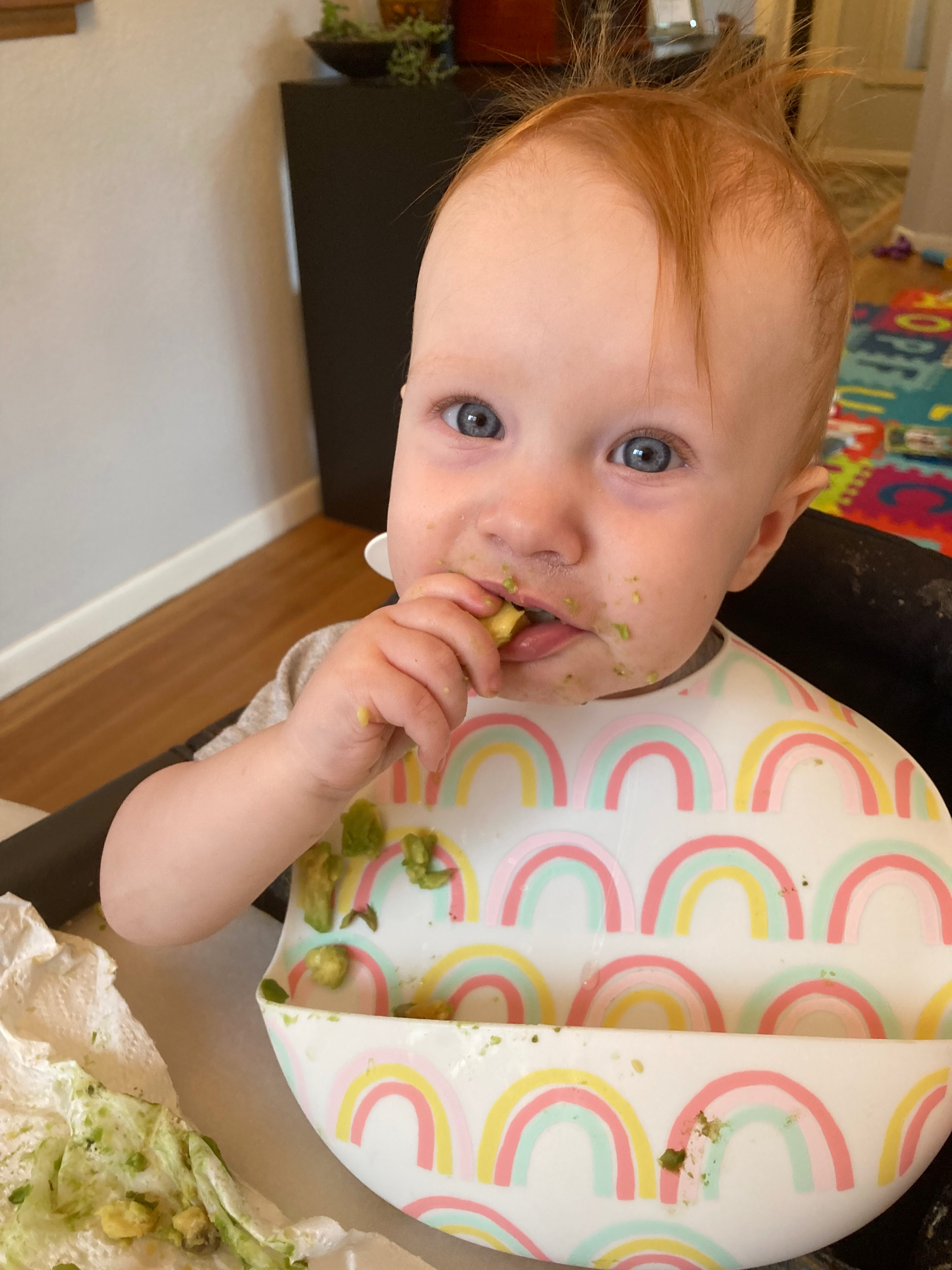
I ended the day babysitting Margot. At ten months, she can stand and take a few steps. And she loves stuffing her cheeks with avocado.
I appreciate all the virtual high-fives from everyone last weekend for completing my marathon goal. I made certain to post all the race photos that cast me in the best light. Now for thoughts on training for a marathon in just ten weeks. To be clear, I don’t recommend a ten week plan, but I have a few observations from my experience that you might find useful as part of a more traditional training approach.
***On Dieting ***
For those of you consumed by thoughts of losing weight, I’ll share my experience. I gained 20 pounds in 2020 out of emotional stress, one too many glasses of Malbec each night, and my own cooking. A weekly Mr. Gattis Sampler pizza figured in there somewhere too. I didn’t intentionally begin a diet in January, but I changed my habits nonetheless.
I returned home in January to my wife’s cooking and stopped drinking. I lost 15 pounds in 3 months. I call this an unintentional diet because my wife doesn’t cook much meat, especially red meat, and I wasn’t looking to stop drinking but she wasn’t and she’s a team player. I was only running on weekends at that point. I maintained that routine throughout the summer with very light drinking, until August when my melancholy demanded progress. I did try to diet then but it didn’t work out.
I thought I needed to lose more than those 15 pounds to run a marathon, I was thinking another 20 to 25 pounds because I’ve run marathons well in the past at 175 pounds. Weight does matter in distance running if you want to run fast. What I learned in my ten weeks was that I could run comfortably at 193 pounds, which was my weight last Sunday, so it was okay that I only lost another 4 pounds.
My goal was to complete a marathon, not run fast. I can tell you that my experience was just as satisfying in this run as in all past marathons. By the way, after burning through 4000 calories in those four and a half hours, I weighed 189 when I got home.
***Motivation ***
The catalyst that precipitated my focus was serving as crew chief to my son-in-law’s 100 Kilometer alpine trail ultra. It was too much for me to gather in the forest with all those elite, perfect, runners’ bodies.
It’s one thing to watch a game on TV or from the stands. It’s another to be on the field in the middle of the spectacle. I fantasize about competing in the Olympics on many of my runs and when I’m standing amidst Michelangelo’s running Davids, I believe I’m living my dream. When you sign up for these extreme events, they let you literally stand right next to these beautifully exposed runners’ bodies. I forget that I’m fat and I feel like I belong there.
I don’t mind saying this because my wife knows I married her for her dancer’s legs, and because she still dances, that I mostly love the women runners’ legs, shaved and with such smooth curves of power. And I’m not too embarrassed to admit that I covet some of the men’s forms too. I want that for myself.
My motivation sounds vain now that I’ve written it, but doesn’t something like running a marathon have to be? You show me an elite athlete and I’ll show you a narcissist. Non-runners think of marathoners as masochists but no, they’re just in love with their own bodies. I noticed last Sunday that many of the men have taken to shaving their legs too.
***Training ***
I’d been running weekends so I wasn’t starting from scratch. After committing to my plan though, I was disillusioned because I had to mostly train indoors on the elliptical the first two weeks, due to extremely poor air quality from the forest fires. Ironically, that probably worked in my favor. It kept me from exceeding my limits at the start. I did push myself hard, going for upwards of two hours on the elliptical. But there is zero impact on those machines and my body wasn’t nearly as sore or exhausted and I was able to easily recover for the next day. I think the elliptical helped to mitigate the potential negative impact of training too hard, too fast. Take what you want from that but in my experience, it’s not unusual to over exert yourself and then lose days for recovery time.
And, because I was concerned the elliptical wasn’t enough, I spent cycles on calisthenics and a little bit of weight lifting. I’m always too tired to do that after a run but had the energy training indoors and developed a good routine with squats, leg raises and planks. I lost absolutely zero weight the first four weeks, but people were complimenting me on my apparent weight loss. Best I can tell is that a daily two-minute plank toned up my abdomen enough that I gained two notches on my belt. I’d never done planks with any regularity before and had no idea at how effective they were. It did take me four weeks to go from one to two minutes. The lesson there, beyond the specific value of planks, is the benefit of strength training.
When I finally got outdoors, the new body tone helped considerably with my running, but I still had to learn how to run slow. I would often run Saturdays on an extremely hilly course and could run upwards of 8 miles. Then I’d try running on a flat course Sunday and find myself walking after a single mile. I figured I wasn’t able to recover properly because of my age.
Wearing a watch with a heart rate monitor helped me to solve the mystery. The hills forced me to run slow and I was running way too fast on the flat course. I had to learn how to run slow. It’s harder than you’d think. I found the heart rate monitor to be a better tool than monitoring my pace. Maybe this is only interesting to me, but every time I refocus efforts on running, it’s like I have to relearn how to run. Don’t assume you know what you’re doing.
***The Grandpa Runner ***
Even after I learned to run slow, some days my heart would race, forcing me to walk. Best I can tell, I think it was the temperature from really hot days. I freaked out enough though to buy a more accurate heart rate monitor – the type with a chest strap and technically an ECG or electrocardiograph. I don’t mind admitting that I was concerned about having a heart attack in my marathon. Something about getting older. I became a grandfather a few weeks earlier.
My concerns were partly warranted because I have a condition called tachycardia Arrhythmia where my heart just randomly switches from the primary node to a secondary node to generate my heart beat. And that second node beats a ton faster than the first. I initially suspected that might be what was behind my heart occasionally racing from 135 bpm to 170 bpm on my runs.
When a cardiologist explained this to me at 25, he said the symptoms might disappear in my 50s. I think he was right because I’ve had a couple of ECGs since then and I know the condition has disappeared for my normal resting heart rate. But at 25 the symptoms went away at a slightly elevated heart rate and reappeared again at a yet higher heart rate, as diagnosed on a treadmill. I wondered if it wasn’t still happening now while running.
I have more to study yet on my heart rate monitor to know that I’m reading it correctly. Actually, I did read up on it and I know I’ll have to share the file with my doctor to understand it properly. An ECG chart is different from what I’m displaying above and it’s complicated. But rising body heat or running over four hours will start to raise my heart rate to where slowing down my pace isn’t good enough and I have to walk for a minute or so to recover. That’s fine. The above chart shows my heart rate held really steady throughout the marathon, under 140 bpm, but then started to shoot up past 170 in the last six miles, even though I wasn’t accelerating my pace. My max heart rate is defined as 160.
My point in sharing the heart rate details with you is partly because I think it’s some cool running tech, but also to stress that I’m not cavalier about my health. I get the sense sometimes that people think I train and run too hard and am not careful enough considering my age. I took measures to monitor my heart rate and shamelessly walked when I saw it was too high. I felt strong enough to continue running but I wasn’t so vain as to risk my health. It probably only added five minutes to my overall time and didn’t take away from my sense of accomplishment. And I know what I don’t know, so I’ll be sharing my data with a doctor for expert analysis. I’m 59. I hope to be 60 some day and to still be running marathons.
I ran the Boulder Marathon this morning. Four years after my last marathon. Not sure if I can explain why running 26 miles was important to me. Let’s just say 2020 was hard and I wasn’t happy with my weight gain. I wanted to be a runner again and running a marathon seemed like the best way to become one. That’s how runners think.
Same road as the first photo, Oxford Road, but headed back west at 11 miles
Although most of the race was run on the Boulder Backroads, as in past Boulder Marathons, this one finished downtown on Pearl Street, so the organizers branded it as the Boulderthon. Who am I to consider that kitschy? Well, I’m a product manager. I understand marketing, it’s one of the hats I wear more frequently at work. I’ve named my share of products. Given that the biggest draw of this event, per the race organizers, is the downtown finish on Pearl Street, I’d have named it the Pearl Street Marathon. Think Colfax. Think Peach Street. Something meaningful to the locals. That would have differentiated it from past Boulder Marathons. I shouldn’t complain though. The event could not have been more well run.
15 miles into it at Coot Lake
Karen and I spent the night at the Hotel Boulderado. There’s no parking at the race start at the Boulder Res, and I didn’t want to make her drop me off so early, plus the hotel is near the finish on the Pearl Street Mall. We enjoyed a nice dinner at the hotel restaurant, Spruce, Farm & Fish where I ate raw oysters and Cod. That thing about runners eating pasta before a marathon is a myth. There were also buses lined up near the hotel to ferry me to the race start in the morning.
Beginning to slow down at 19 miles
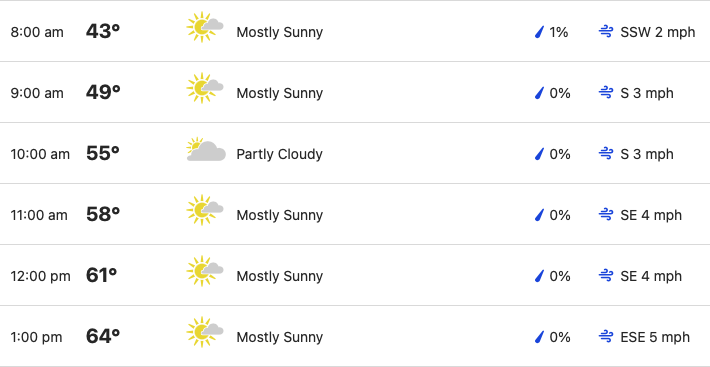
The weather was awesome and likely helped me to do better than expected. 43° at the start. Low 60s by the finish.
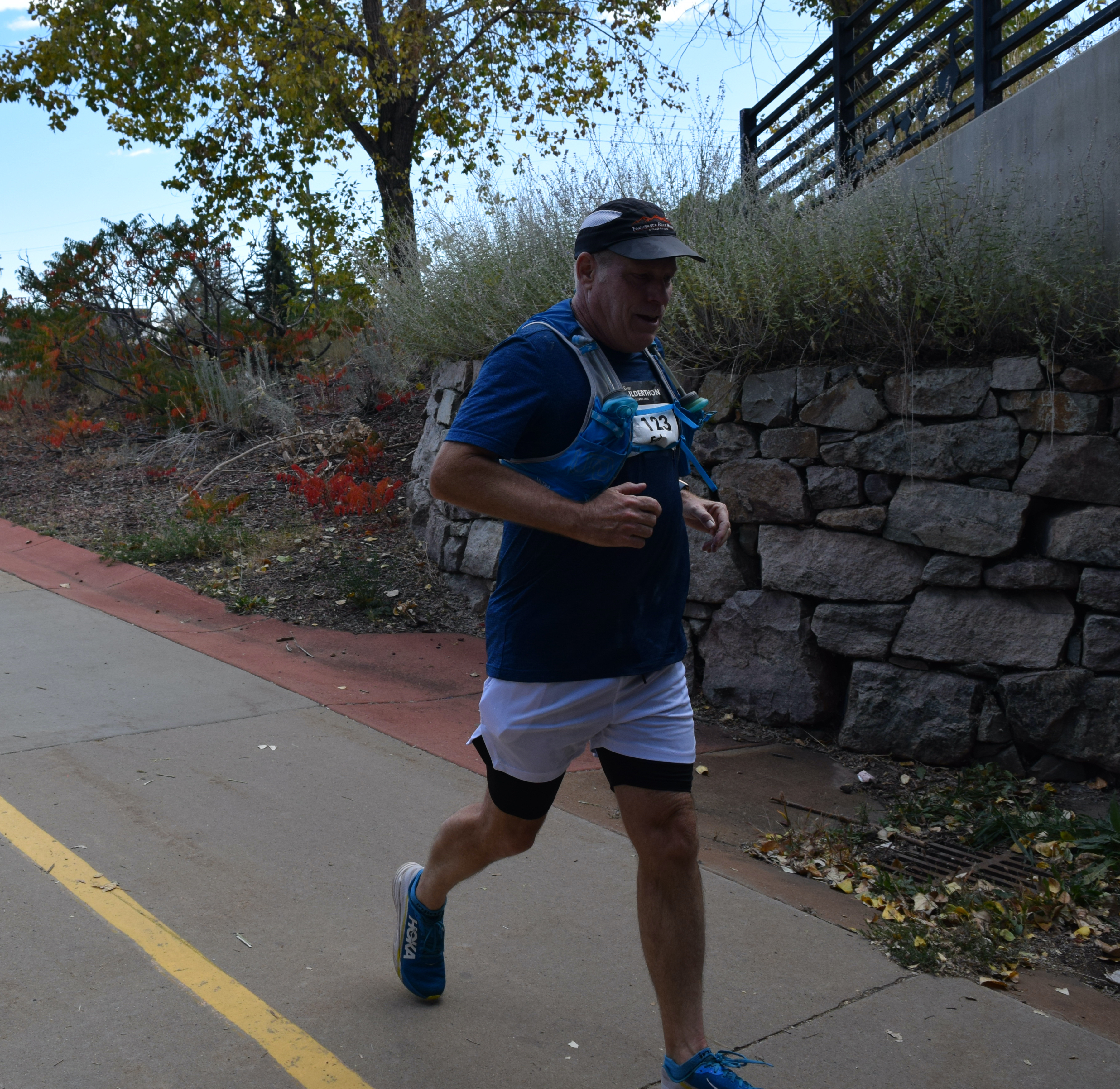
Nothing stretches distance out longer than straightness, and this course had some long, straight roads. The half-mile-long dam at the Res was the worst. Because it’s straight in every dimension, it felt like three miles. Oxford Road was about four miles of straightness, but at least it undulated vertically with some hills. Still, I felt really good the first half and didn’t start to feel fatigued until mile sixteen. I pretty much ran to the race plan I shared last weekend, except I ran a bit faster overall; 50 seconds per mile faster in the first half and 10 seconds faster per mile in the second half.
22 miles and still running
My breathing felt great this entire run. I never once felt like I wasn’t going to finish. I did start walking a bit at the aid stations to drink and douse my head with water in the final 10K. I also walked a tad whenever my heart would start to race past my max heart rate. I found I could recover after a half minute or so of walking. This was also in the final 10K. Still, I finished well ahead of my goal, in 4:35.
At 24 miles and ready for it to be over
My legs tightened up after twenty miles and shortened my stride, but I never came close to cramping. I helped a runner out at 23 miles by giving him the rest of my pickle juice when I discovered him on the side of the trail with cramps. I had two 17 ounce water bottles, one with Tailwind, a high-calorie sports drink that’s not at all sweet tasting, and the other with dill pickle juice. You won’t find a sports drink with anywhere near the sodium as pickle juice. It has more salt than the Dead Sea. But I drink it because it tastes good.
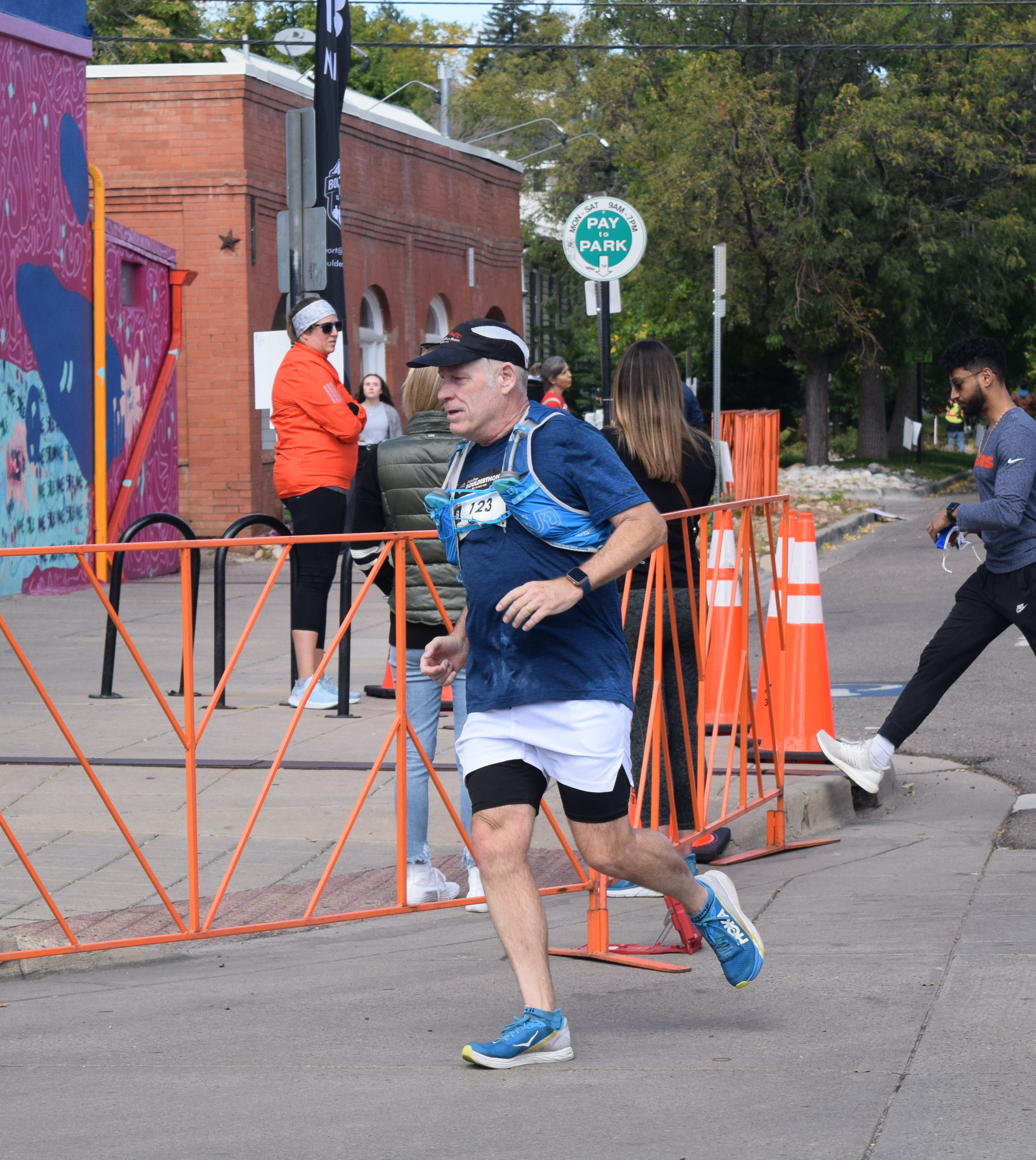
Turning onto Pearl Street at 26 miles
As usual, I found religion those final six miles. Because I didn’t want to disappoint God, I made promises I couldn’t keep with the Devil. I’m kidding of course, but man, the things you say to yourself to get across the finish line. The twenty-fifth mile was uphill with a quick downhill near the end. Colorado races will always throw a hill at you near the end. Race Directors are cruel.
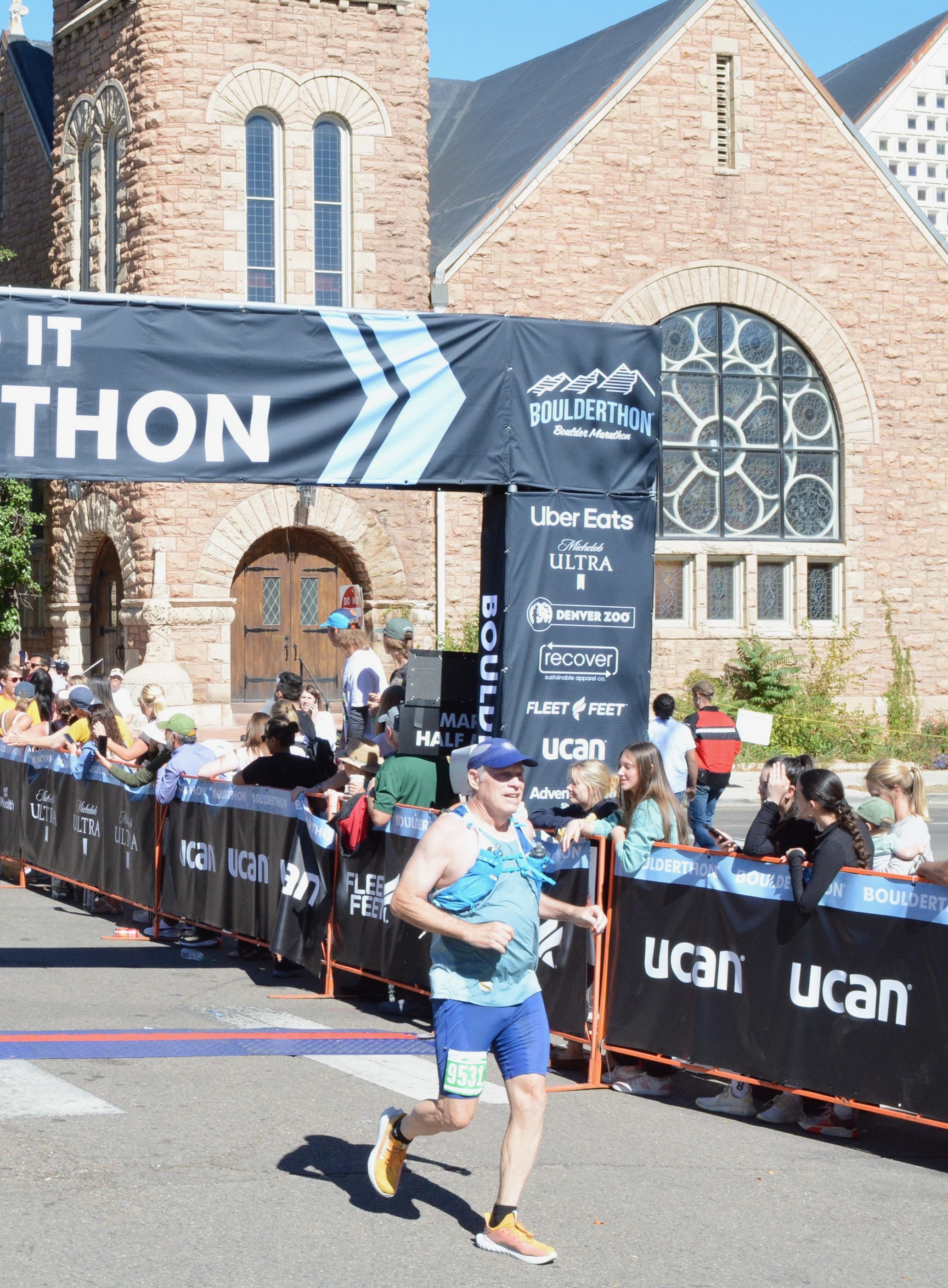
The final kick
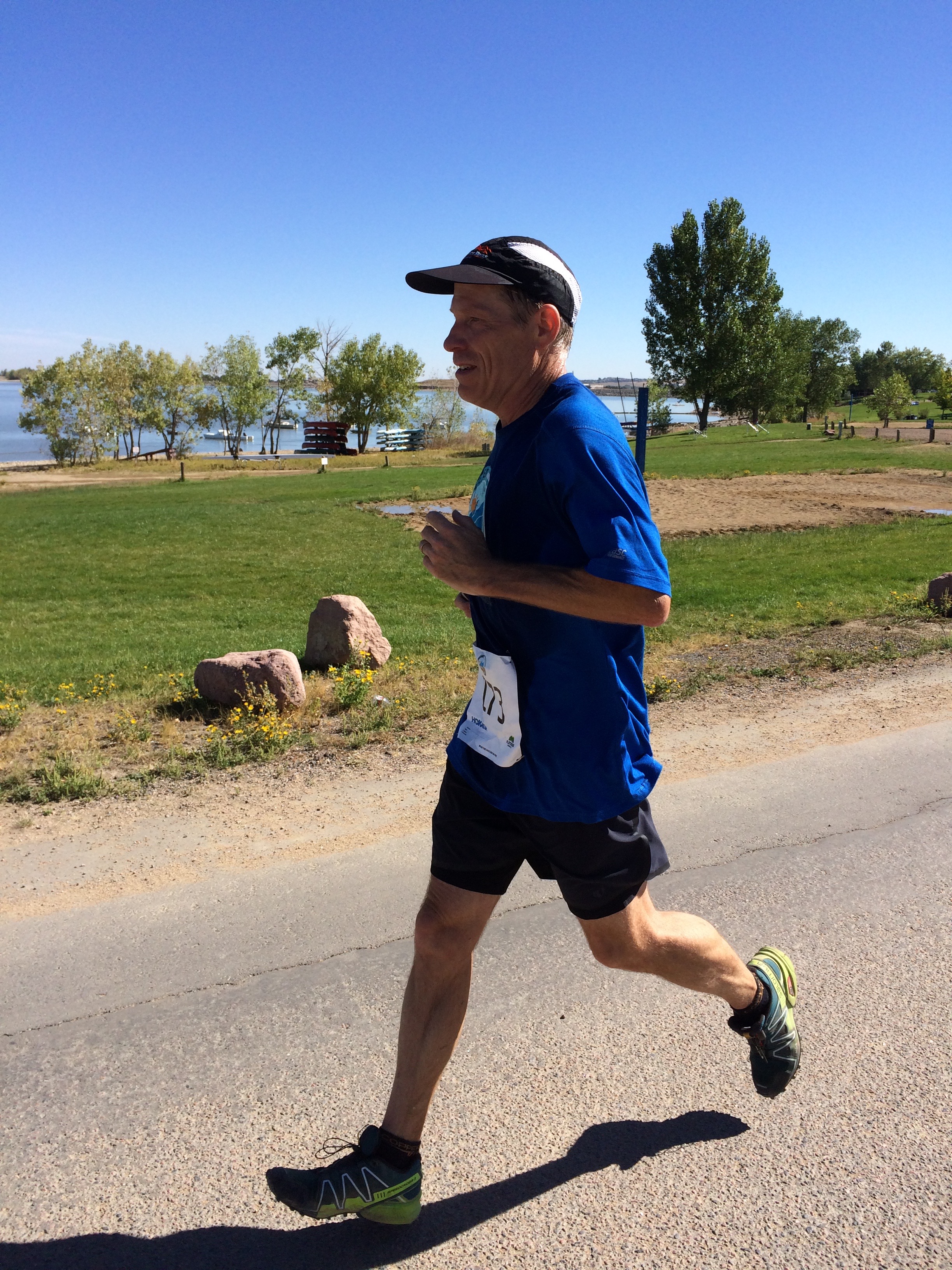
I wouldn’t say I put on a kick, but I did finish strong. Karen and friends were there at the finish. Chris Price served as my crew chief and took all these photos. He rode around the course on his bike, ready to resupply my sports drinks, or carry me off if I DNF’d.
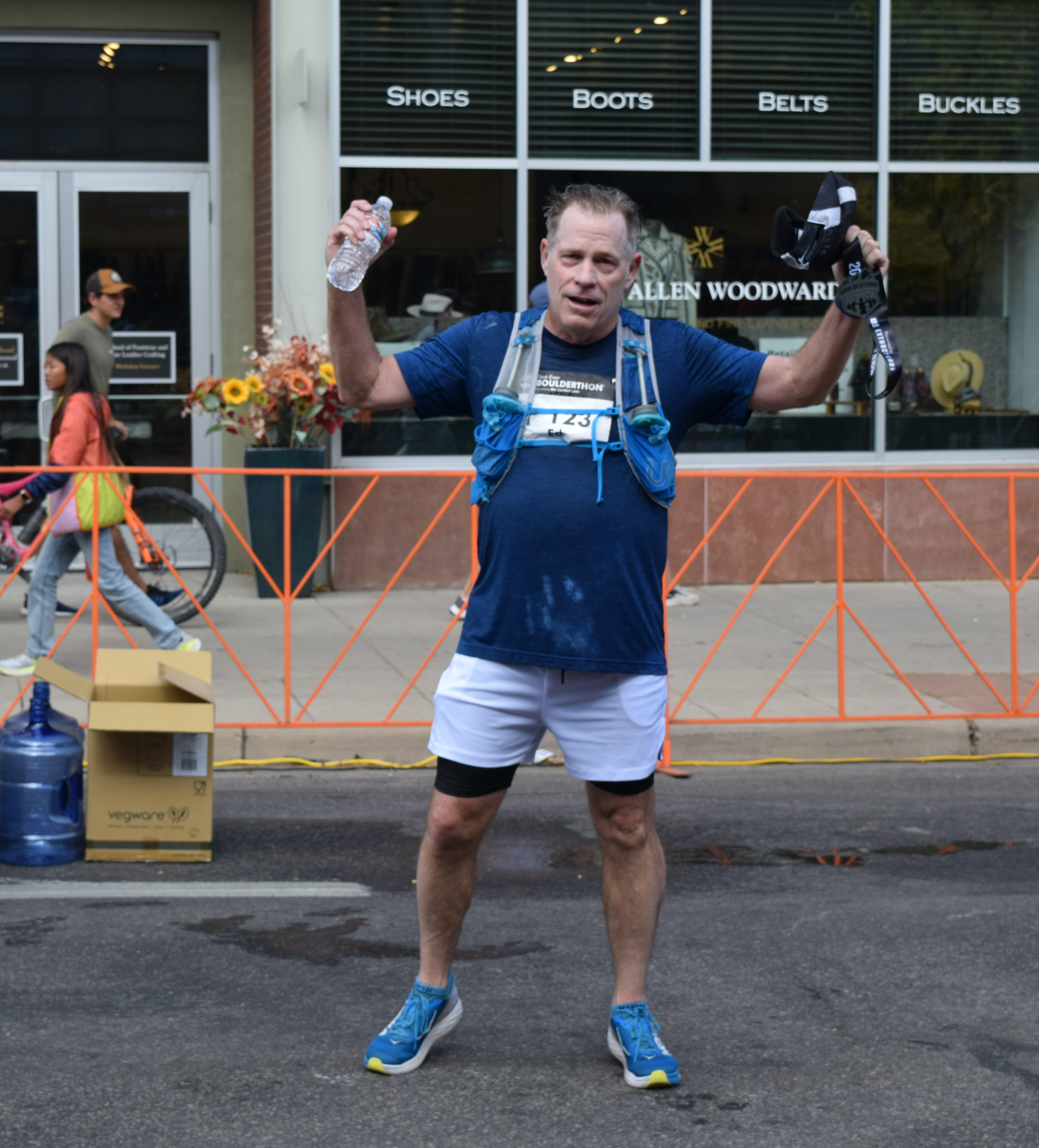
My first marathon as a grandfather
Finished 5th in my age group, even though I was 4th and an hour quicker in my last Boulder Marathon. I think other competing marathons in October, or Covid, and maybe the poor air quality this summer, diluted this year’s competition. The first two weeks of my ten week training plan was inside on the elliptical to avoid the unhealthy air quality. I wasn’t as fit as I’d hoped to be for this event, but man, it felt good to run it. I’m a runner again.
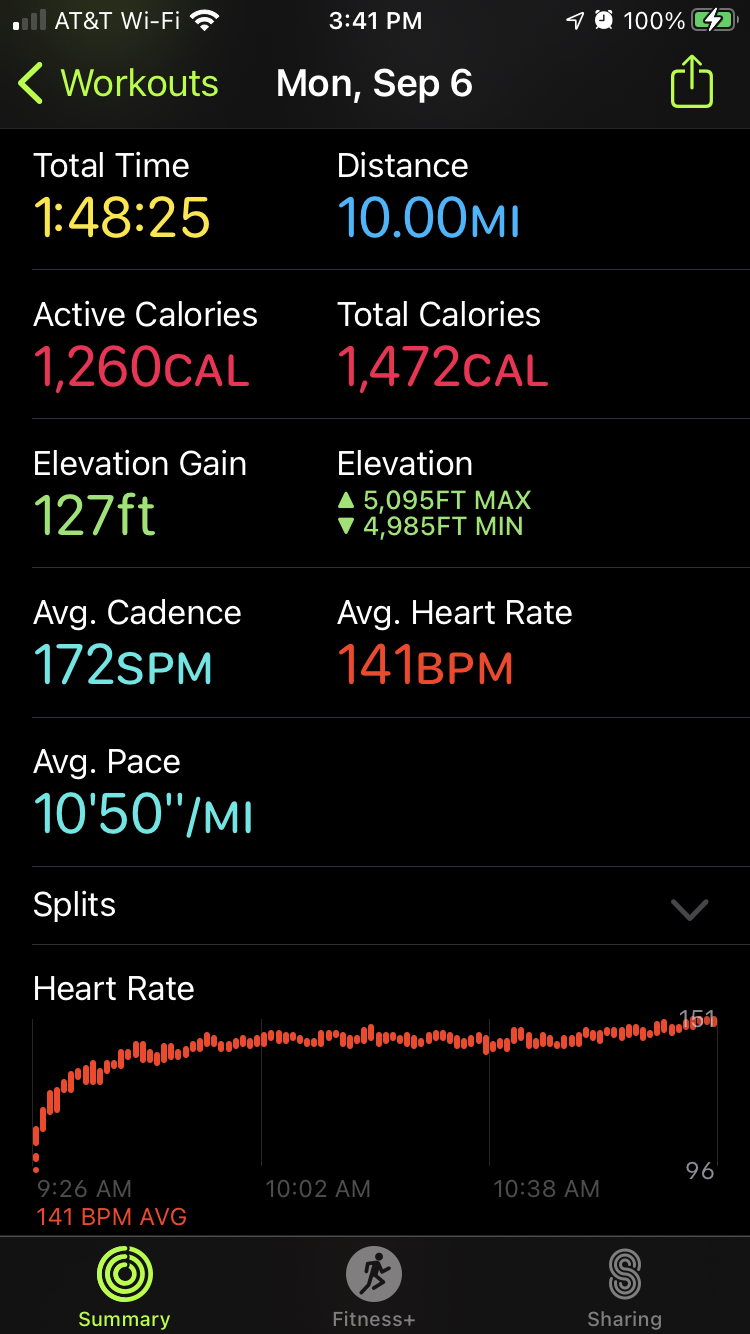
Sharing my stats is a clear sign I’m beginning to exhibit compulsive runner behavior, but it’s a runner’s blog, so there you go. Sharing my stats from today’s ten miler to illustrate how I’m going to use my heart rate monitor as my primary tool to get me to the finish line. Now that I’m tracking my stats, I’ve discovered that I have been starting to walk/run once my heart rate exceeds 160 beats per minute (BPM). That’s a function of my current fitness which I could no doubt exceed if I were twenty-five pounds lighter. In fact I have. Below are my stats from my last marathon four years ago.
You use the BPM tool like this. Subtract your age from 220 to know your max heart rate. Mine is 161. Four years ago, mine was 165. Experts say you should target running between 50% and 85% of your max heart rate. At 85%, that suggests I should run with my heart rate around 136, or four years ago, around 140.
During today’s run, I read my heart rate at 144 BPM just short of four miles. I purposely slowed myself down, by shortening my stride (my stats proved I maintained my cadence), and monitored it closely so that I didn’t reach 160. I was able to actually slow it down a couple of beats, although it crept back up to 151 by the end of the run. My experience was that I was able to comfortably run ten miles.
You might notice that my stats from the Colorado Marathon four years ago show I averaged more than 10 BPM over my max heart rate for the duration. Apparently, it’s not a sudden death limit as my max was over 200. Probably lucky to still be alive, but I was much more fit back then. You might also notice the Apple Watch graphing software really sort of sucked four years ago.
I’ll practice this more but I suspect if I can maintain a pace around eleven minutes per mile, I’ll be able to keep my heart rate below 150 and that will enable me to keep running. Maybe even below 140, which is what I should really target to avoid a heart attack. I’ve always enjoyed running without a watch, but I have to say, tech is cool.
In addition to perhaps a haircut, I could use more time. Six more weeks of training doesn’t feel like enough to me to prepare for my first marathon in four years. How did four years fly by? But I will say, I’m making progress. I ran nine miles today on the Boulder backroads at a ten minute pace. That gives me some confidence.
Still, I’m mostly not confident at all that I can finish a marathon. I forget when I started but I’ve been doing that 16/8 diet for four or five weeks. It’s an intermittent fasting derivative where I eat in an eight hour window – generally 10am to 6pm. I’ve heard unbelievable stories of massive weight loss. I’ve yet to lose one pound. One pound! Seriously.
I could say my weight range has narrowed. I used to range from 197 to 203 pounds. Now, if I even go near a scale, I’m consistently 197 pounds. I’m at the point I could stop weighing myself and just ask Alexa. You could probably ask her in your kitchen, “Alexa, how much does Ed Mahoney weigh?” She’ll answer, “197 pounds.” So maybe that’s progress.
The scary part is, I’ve never run a marathon weighing more than 185 pounds. And between you and me, that run didn’t go all that well. But I’m fine now with running slow. My ego no longer needs to break 4 hours. I’ll accept any time under 6 hours to avoid being swept off the course when they re-open the streets for traffic. Based on recent workouts, I suspect I might finish in about 5 hours, assuming I finish at all.
It felt good today to know I can run 9 miles strong. Normally I’d work myself up to 21 or 22 miles before a marathon, but the goal posts have moved in a bit given my current limitations. I’d like to work myself up to 15 mile runs on the weekends. That’s longer than a half marathon, which will make dropping to the Boulder Half Marathon pointless, and it’s long enough to train my body to run with a calorie deficit.
I only have time for long runs on the weekends because I pivoted this last week to morning runs. The cooler morning temps help me to run better, and I’m more consistent. Anything can get in the way at the end of the day. I wasn’t really doing anything in the mornings either, other than sipping coffee and staring out the window for the newspaper to arrive. For me to do anything halfway constructive in the early mornings is a testament to my commitment. One more thing to give me confidence. If I could lose just one pound though, that would be nice.
Karen and I took golf lessons today at the Broadmoor Hotel in Colorado Springs. We’re looking for another activity that we can do together. Our others are hiking and snowshoeing, which are sort of the same thing, just in different seasons. Otherwise, she’s a dancer and I’m a runner. I’m glad we are starting out with lessons. I recall learning to ski when I was twenty. My brother took me to the very top of the mountain at Keystone and told me I’d learn on the way down. I’m not the best skier. The golf course at the Broadmoor is simply spectacular.
I ran NCAA Cross Country, so forgive me if I think golf courses are for running. I’d love to run this one. Instead, I had to tuck my shirt into my shorts and wear a belt. I’m no fashion maven, but pot-bellied men should wear their shirts untucked. Before our golf outing though, before 7am in fact, I ran four miles on a gorgeous trail. Only four because there was some high-altitude incline involved. There are some serious trails just outside the door at the Broadmoor.
We’re here celebrating Karen’s birthday, which is really next week, and our 34th wedding anniversary, which was really on August 1st. We’ll self-quarantine after this to prepare for becoming grandparents. Baby Margot Faye is due on September 11th. Until then, the next three days will be early morning trail runs (still training for the Boulder Marathon) followed by afternoon writing sessions. Vacations are awesome.
Like Neo and Trinity rising above the fray, I could see blue skies on my run today. I could not only see the foothills, I could see the trees on the hills. Of course, the cloudless, azure sky meant it was also really hot, but I won’t complain. I tried to take a photo over the Left Hand Creek bridge, but I struggled centering the camera.
Not my best run today, I walked a bit more than I expected, but it was only fourteen hours after yesterday’s run and my legs were still heavy. Yesterday’s run was my best of the year. I ran seven and felt like I’d found my legs halfway into it. I’m not timing myself but I suspect I ran a ten minute mile pace on the way out and closer to nine on the return. It just felt good.
No speed today but so many things were good about it. Being able to breathe and see the sky were the best things. Next was that I got out on the Boulder backroads to run part of the course for the upcoming marathon. Getting out here will tell me if I’m ready for the real thing. It’s still a long shot that I’ll be able to run a marathon in October, but I can switch to the half marathon at the race expo. Until then, I’m going to keep pretending I’m training for a marathon.
Today was also my farthest distance of the year at eleven miles. Most miles actually since the Austin Half Marathon on February 16th, 2020. And I practiced both hydrating and eating a gel. I hate friggin gels. My current hydration drink doesn’t have any measureable calories though so I took a Honey Stinger gel. Honey Stinger is the most tolerable that I’ve tried. I have some Hammers but I don’t digest those well. GU gels make me vomit.
I ordered some SIS gels for the race and I’ll practice with them first on training runs. My son-in-law used them on his ultra so I’m gonna give ’em a try. My plan is to carry a couple liters of high-calorie electrolytes so that my hydration satisfies my need for calories and I won’t need gels. The course has abundant aid stations but the FAQs don’t specify the brand for gels and sport drinks. Sort of a glaring miss for the FAQs.
Two weeks of training complete. Eight more weeks of training before race time.
This morning’s Boulder Marathon is what all my massive mileage training is about. Over 600 miles in the heat of July and August. Last weekend’s relay race over Georgia Pass has me feeling confident. Although, working 13 hour days in New York all week and only exercising less than 60 minutes in aggregate on hotel aerobic machinery has me questioning my taper plan. My legs should certainly be fresh. Hopefully the unabated restaurant and bar calories will find purpose twenty miles from now.
Chris and I start out together the first half mile. We’re both wearing shorts and tech t-shirts without gloves despite the 47° starting temperature. It will warm up 1° per mile; we couldn’t ask for better weather. Chris is running the half marathon and surges ahead of me in the first mile. I’m not wearing my Garmin, it’s recording stats but in my pocket. I’ll relate my mile splits here but I don’t know them while I run. I run my first mile in 7:42. The only bad start in a marathon is one that goes out too fast. This is probably too fast but it is mostly downhill. The next five miles are up hill.
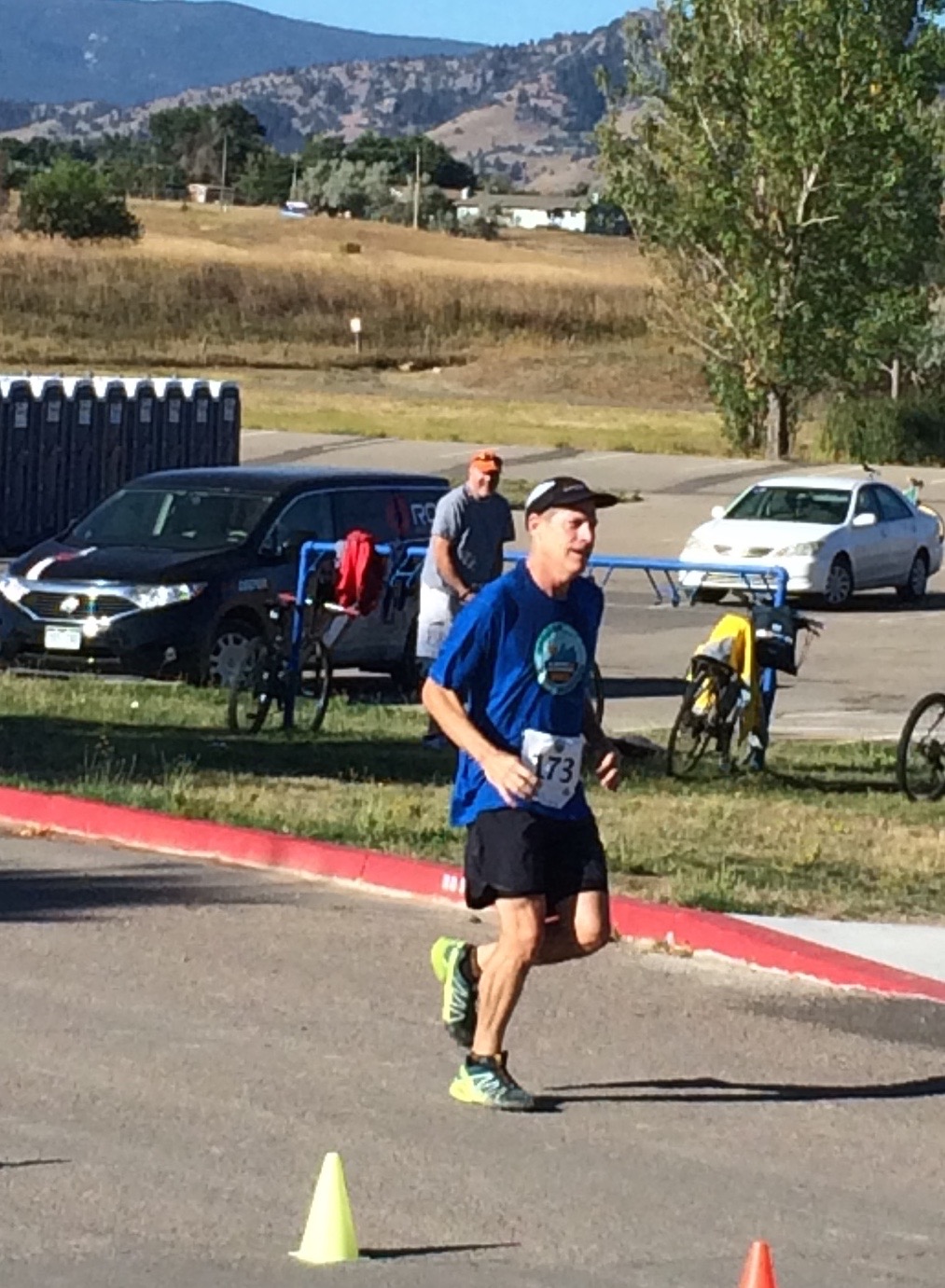
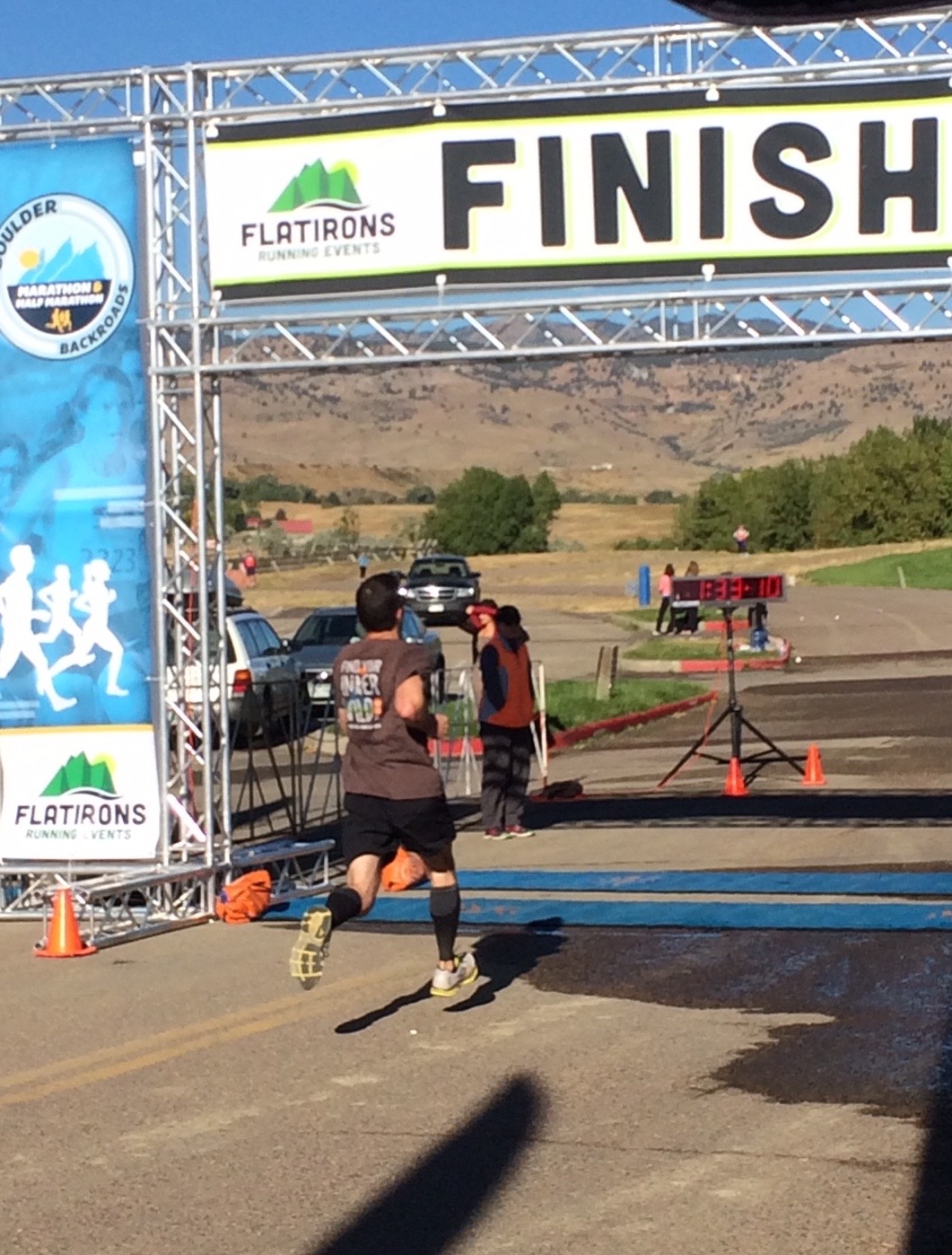
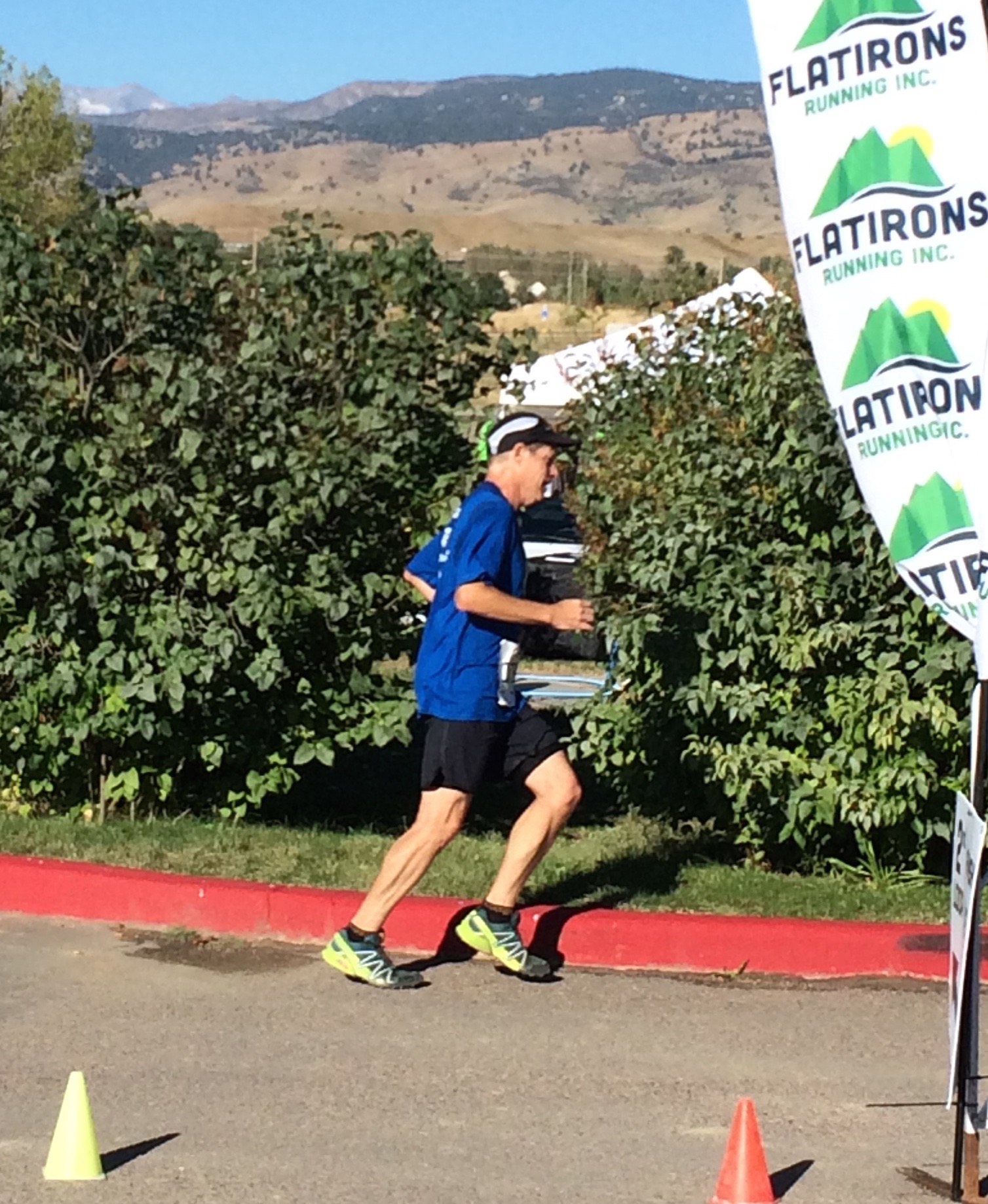
Still, my next four miles are in 7:23, 7:32, 7:49, and 7:49. I watch Chris this whole time race about 200 meters ahead of me against two guys in blue and one in yellow. There are less than 400 runners between the full and half marathons, so we’re completely spread out after two miles. Chris drops the two blues before hitting Niwot Road at three miles and runs even with the yellow guy until five miles. At this point, Chris surges and increases his lead over me to a quarter mile. The yellow guy surges a couple of minutes after Chris, but never again reaches him. Chris sees me after a goofy loop-back turn off Oxford Road and puts on a massive surge that takes him out of sight for me until I see him at the half finish. This photo shows his kick near the end.
Chris finishes 5th in his age division and 34th overall. I think the half is more competitive than the full. You get a sense of how fast Chris kicks in this finish photo based on how high his feet are off the ground. His 1:33 is a personal record.
I cross the half six minutes behind Chris in 1:39 – which is a good ten minutes faster than I expected. I see this time on a clock at the Boulder Rez. This is surprisingly fast in a 7:30 pace but I feel strong. I run much of the second 10K with Gadi, a runner who recently moved from Israel to obtain his Masters in Psycology at Naropa University in Boulder. We talk much of the time but he finishes at the half. I’m certain at this point I can run a second 13 miles, I feel that strong. I do expect to slow down on the upcoming hills and do by a minute to an 8:30 pace as the third 10K gains elevation again.
My legs become heavy on the final uphill mile, the 19th mile, but I pick my pace back up at twenty miles. Some other runners begin to surge here, sensing the downward slope. I don’t get into a race though because I know I won’t be able to hold it. My goal all along has been to feel comfortable the entire race, which is why I don’t monitor my watch. I pass a couple of runners on this final 10K and one passes me. After 22 miles, the course turns off Niwot Road onto a trail along an irrigation ditch. The gravel feels like hot coals under my tender feet. This begins my slowdown as my stride significantly shortens.
I tend to describe bonking or hitting the wall in terms of running out of fuel, but this is how it feels. All the muscles in my abdomen and upper legs begin to melt. The heaviness and burning from lactic acid would be preferable to this sensation of vanishing body parts. My slowing pace is like a dream where I’m running but moving in slow motion because I don’t have control. I picture my blood cells moving into my muscles and stealing away without replenishing the lost proteins. It’s a brutal scenario where momentum is only maintained by leaning forward and hoping my legs drop in front of me in time to catch my fall because I haven’t the ability to contract my thighs and lift my knees. I don’t bonk necessarily here but slow down even more at mile 24. This slowdown is more from heavy legs – not nearly as painful as hitting the wall.
The cheering crowd steers me toward the finish line like sirens to the rocks. I yank my Garmin from my pocket at the 26 mile sign and notice I’m close to a 3:30 Boston Qualifying time. I didn’t plan on sprinting to the finish, but pick it up a bit anyway for the final quarter mile. I cross in 3:30:05. Five seconds off qualifying for Boston! This doesn’t actually bother me though because I wasn’t trying to run this fast. Even with my slowdown the final two miles, this marathon was everything I hoped it would be. I felt great. I’m totally satisfied. I never bonked. And my second half was only ten minutes slower than my first, not a bad margin. Good enough for 12th place overall, although only 4th in my age division. 50 year olds are fast in Boulder. I would have either won or taken second in just about every other age group. I complete my day with a massage at 3pm, a steak dinner at 5, and I’m watching CU go into overtime against CSU. Awesome day!
















 A Runner's Story