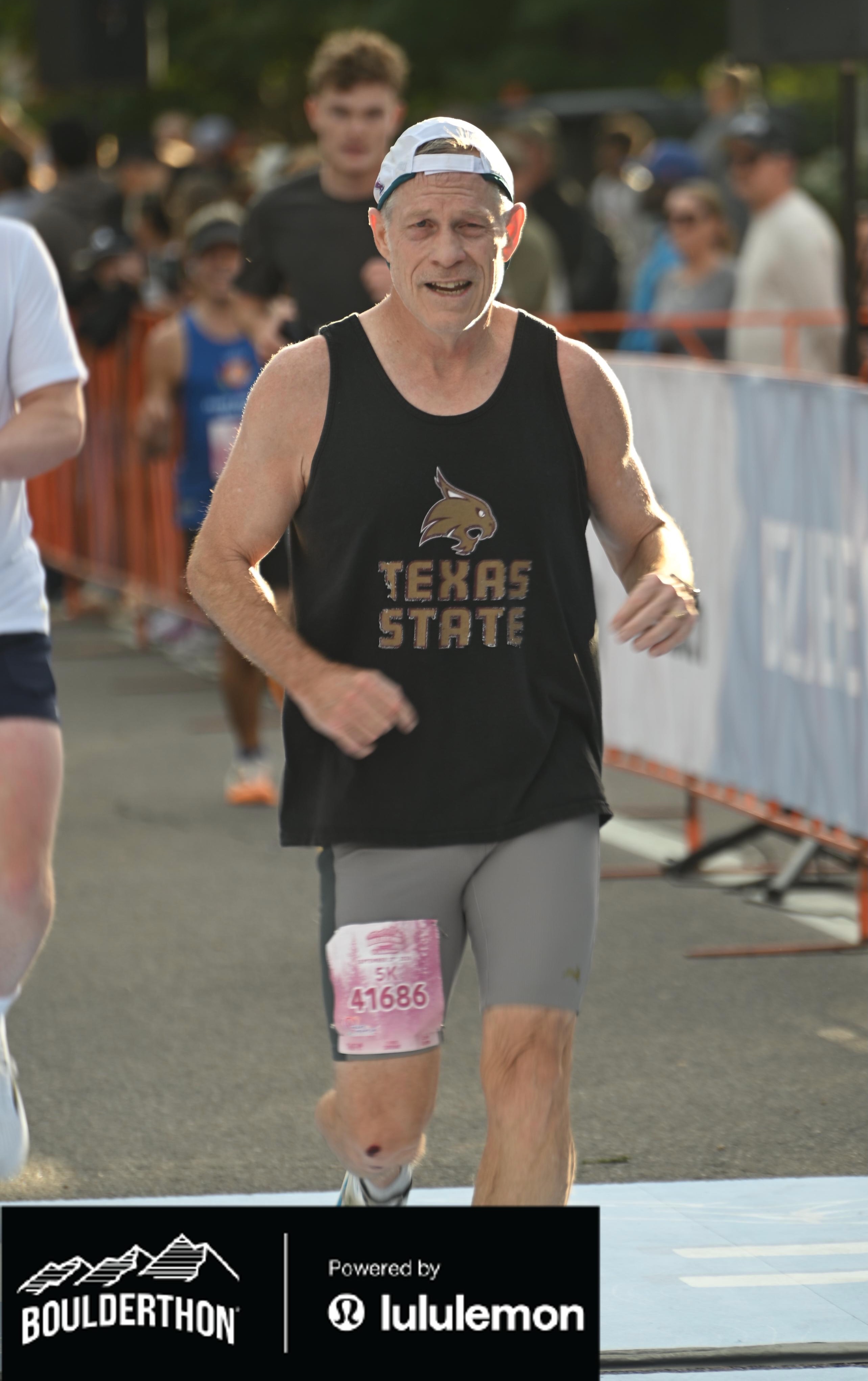
A 5K is short enough that there really isn’t much time to fix a mistake. I learned that Sunday morning.
I lined up for the Boulderthon 5K about three runners deep from the starting line. That was intentional. I didn’t want to spend the first quarter mile weaving around people, and I figured anyone standing that close to the line probably had some idea what they were doing.
I saw people who didn’t belong there but the guy next to me certainly looked like he did. He appeared to be close to my age and was wearing an Athletic Brewing race shirt. We started talking and he told me he was an Athletic Brewing ambassador. That has to be a sweet gig. Athletic Run Wild is currently my favorite IPA. At .5% ABV, drinking it is like microdosing beer.
When the race started, he immediately demonstrated that being an Athletic ambassador apparently also required running fast. He shot off ahead of me. It happened so quickly that I couldn’t even consider chasing after him. He eventually finished about a minute ahead of me.
Unfortunately, I didn’t exactly exercise restraint either. My first mile was 6:50. That was considerably faster than the pace I had planned to run, and my body began informing me of that fairly quickly. By the time I reached 23rd Street, I already had that tingling sensation in my arms that I get when I am pushing hard and fatigue is beginning to spread beyond my legs. My breathing was already heavy and stayed that way for the rest of the race. I’d put myself into oxygen debt. The numbers tell the story almost perfectly.
My first-mile heart rate averaged only 148 beats per minute, partly because my heart rate was still climbing early in the race, but my running power averaged 289 watts. That would be my highest power of any mile. I don’t normally track my power metrics but its inverse relationship to my heart rate tell the story. I had essentially borrowed energy from the rest of the race and the bill was about to come due.
I tried to surge after 23rd Street per plan. For a few moments, it worked. Then it didn’t. I backed off, recovered as much as you can recover while racing a 5K, and tried again during the second mile. Same result. I could accelerate, I just couldn’t hold the acceleration. Mile two slowed to 7:37. My average heart rate climbed to 160, while my power dropped to 268 watts. That’s a pretty concise description of fatigue: my cardiovascular system was working harder while my legs were producing less power. Still, I wasn’t finished trying.
When I reached the turnaround near Foothills, I attempted another surge. Turnarounds naturally provide a little psychological reset. You stop running away from the finish line and finally begin running toward it. I tried to use that. Again, I got the acceleration. Again, I couldn’t sustain it. By the third mile, the early 6:50 oxygen debt had collected nearly everything it was owed.
My third-mile split was 8:13. Heart rate: 162. Power: 262 watts. The trend was obvious:
- 6:50 / 289 watts / 148 bpm
- 7:37 / 268 watts / 160 bpm
- 8:13 / 262 watts / 162 bpm
My pace was slowing. My power was declining. My heart rate was still rising. I hadn’t quit but with a tenth of a mile left, I was running out of race.
I knew I was slowing the final mile as runners began passing me. There is something particularly defeating about being passed late in a 5K. In a marathon, someone going by you at mile 20 might simply have paced the race better. You still have six miles to respond. In a 5K, there isn’t much road left.
You either answer or watch them disappear. For most of that final mile, I didn’t have an answer. But as the finish approached, I found some juice. With 200 meters left, I surged again and caught some of the runners who’d passed me earlier. It wasn’t a full-on sprinting kick because part of my plan was to not endanger my tendinopathy, but it felt good to know I still had power left. My final 10th of a mile segment registered at approximately a 6:05-per-mile pace. My heart rate reached 165, and even my power ticked back upward to 267 watts. After declining for nearly the entire race, I reversed the trend.
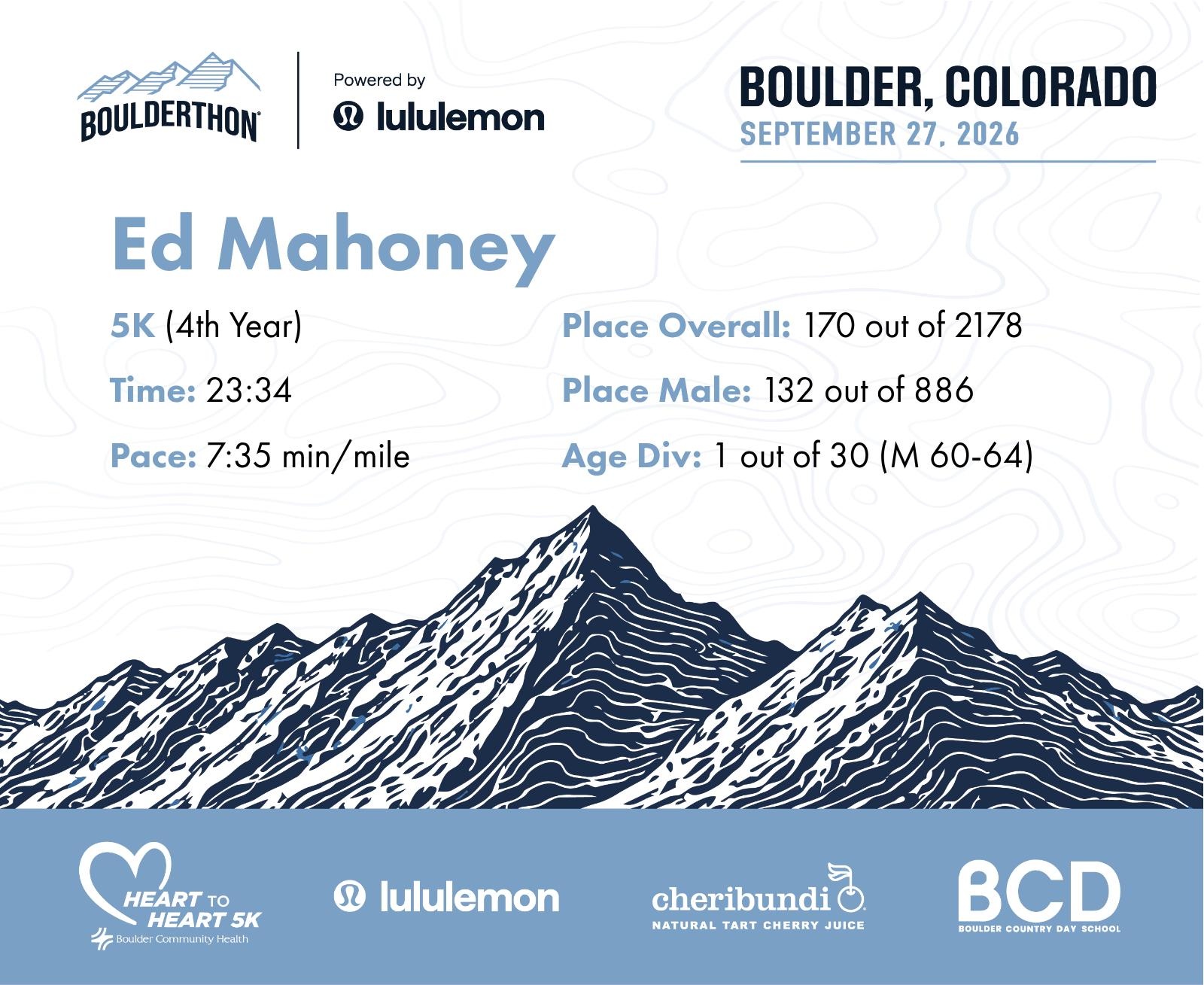
I crossed the line in 23:34, averaging 7:35 per mile. Same pace actually as my Bolder Boulder 10K last May, which I’d started out with a much more controlled first mile. I always start at the back of my wave in that race to use the crowd as a governor.
And then came the part I hadn’t expected. First place. Not first overall, obviously. At sixty-four years old, I’m realistic about the number of shirtless twenty-year-olds I can beat in Boulder. I did beat most of them in my last marathon and that was joyful. I finished first among the 30 men in the 60–64 age group, winning by 3 minutes. For a race in which I spent much of the final two miles feeling like I was gradually coming to a halt, that’s not a bad ending.
The interesting thing about my Apple Fitness app data is that it confirms almost exactly what the race felt like. I went out too fast. The 6:50 first mile and 289 watts were aggressive. After that, my power declined every mile even as my heart rate rose from 148 to 160 to 162. That’s not the racing plan I shared in my pre-race blog post, but the finish tells me something else.
After an 8:13 third mile, I was still capable of accelerating to a 6:05 pace at the end. So the speed was there. I had just spent too much of it too early. A better race would have been a 7:15 or 7:20 first mile, followed by progressively faster miles and a real kick to the finish. You don’t get to rewind to the starting line and try again but I do intend to start training to race the 5K. Training for a 5K will prep my body for both knowing my pace and holding it.
What happened Sunday was pretty simple. I stood three deep from the starting line. I ran the first mile in 6:50. I paid for it. I kept trying to surge anyway. And when there was almost nothing left, I found enough for one more surge. 23:34. First in the 60–64 age group. A good 5K baseline performance and I’ll take it. I’ll test my 5K training progress with the Shoes & Brews 5K November 7th and should then be ready for an aggressive race in the Colder Bolder December 5th as a more seasoned 5K runner.