
Tags
It’s not very likely I can gain anymore fitness in the two weeks leading up to the Bolder Boulder. But I would very much like to gain some speed. My 8 minute pace in the Colorado Marathon still feels fast to me, but not for a 10K. Odds are, I’m not going to run a much faster pace. I think what I can do in this short training window is to allow my legs to discover speed.
It’s not about training. I am working in some tempo runs and 100 meter strides in the grass after my runs, that’s simply to show my legs what speed feels like. Sometimes your legs have to be shown how it’s done. It would take weeks, if not months, for tempo runs to improve my fitness. I just need to get my legs out of their routine, their 8 minute pace rut, and feeling the vibes of a 7:30 minute pace.
I’m not sure at what pace my lactate threshold is. I want to think somewhere in the 7 minute range. This will dictate just how much under an 8 minute pace I’ll be able to run. I know that I can’t hold a 7 minute pace for a full mile. I’ve recently tried. I just ran the first half of a marathon below an 8 minute pace. Somewhere between 7:20 and 7:40 might be doable. Ten years ago, I managed a 7:11 pace and placed 4th for my age. My 3:31 marathon matched my times from ten years ago. Maybe this 10K will too?
It’s also likely my lactate threshold begins at 9 minutes. I start to feel like I’m running fast at the pace. That doesn’t mean I can’t hold a 7 minute pace for awhile. It means I should warm up and start out slow. Take what the course gives me, which is that downslope at High Street.
The trick will be to warm up before the race start. That’s a bit difficult sometimes with a bunch of waves starting ahead of me but I’ll do something. Jumping Jacks if I have to. That will allow me to start out at a 7:45 pace without going into oxygen debt. Warming up does quite literally that, it raises the muscle temperature. It increases blood flow to working muscles, it speeds oxygen delivery, it improves running economy, activates the nervous system, and reduces the oxygen deficit in the first few minutes. Warming up allows you to start out faster.
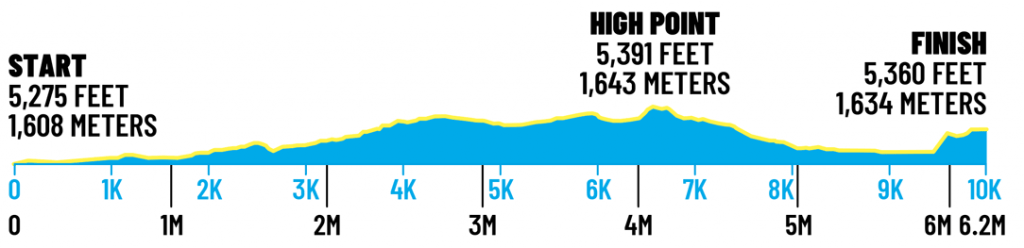
It’ll take a 7:30 pace to place top 3 and that’s the goal. A smart strategy would be to go out at a 7:45 to 8 minute pace the first mile and then try to improve on that. The elites and anyone racing typically start slow and run their fastest pace on mile 5. That leg starts at the high point of the course, where aptly-named High Street crosses 13th Street and runs through downtown. It’s a fast mile. Maybe, if I’m racing well, I can rip off a 7 minute flat pace and then hold on for the finish.
My goal is to start out at a 7:45 pace for miles 1 and 2. Then drop it to 7:30 for miles 3 and 4. I have confidence in that first goal. The 2nd goal might be delusional, but it’s where I can position myself for a podium finish. Goal 3 is to run mile 5 at a 7:15 pace and then just hang on for mile 6, maybe 7:30 to 7:45. All miles under an 8 minute pace. That’s my race plan. Overly aggressive but I was taken to task for underestimating my Colorado Marathon pace. No one was more surprised than me by that.
I’ll have to be racing those last two miles, but that’s what’s fun about this course if you run it like I just described. It’s a 10K that’s also a 2-mile race. You don’t do anything too strenuous the first 4 miles and then have fun racing through downtown and up into Folsom Stadium. It’s a kick.
This is probably narcissistic but I love having a part of my life where I just turned back the clock ten years. And I like that it’s something physical. It’s not my thinning hair but it’s something I can control. I take what the course gives me. I’d love to match my BB10K time from ten years ago.
 A Runner's Story